
Monitoring and/or Intelligence Analysts are extremely important professionals.
They are the ones who feed the Institutional and Government Relations (IGR or GovRel) team with information to support the decision-making process.
And not only to monitor/analyze the processing of bills. But also to observe/evaluate the movements of stakeholders, among other functions.
It is not an easy job. It requires a lot of concentration and knowledge. But this monitoring and analysis process can be much faster and more effective.
To help you save time, we share a summary of our methodology and some tips that we apply daily in our Sigalei intelligence service.
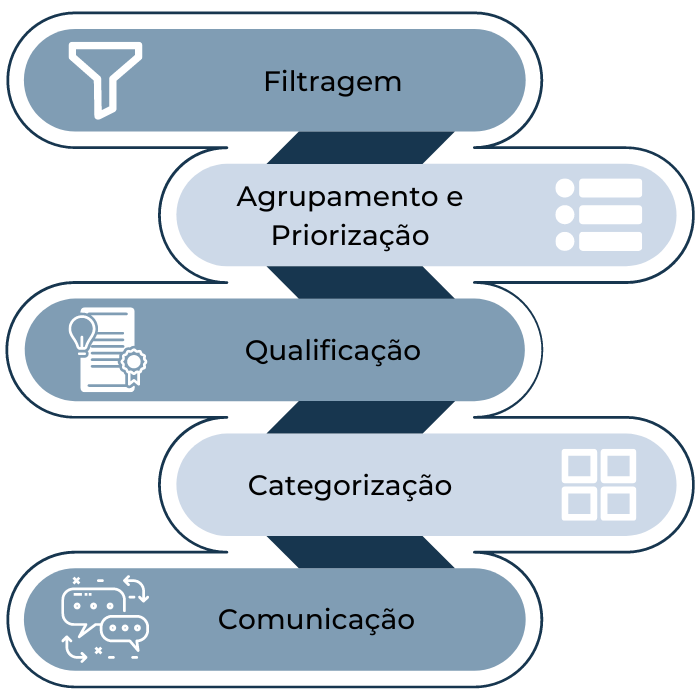
First of all, you need to think of the monitoring process in 5 steps:
1. Filtering;
2. Grouping and Prioritization;
3. Qualification;
4. Categorization;
5. Communication.
See how each of these steps works:
1. Filtering: the first step to monitor
What type of information will you analyze?
And what will be left aside?
These two questions are inescapable for good IGR monitoring.
In this mission, the first step is to evaluate how to parameterize the monitoring filter. You can't make a mistake here. If you open it too much, you'll receive a lot of garbage. If you close it more than necessary, you run the risk of losing useful information.
Therefore, using a tool in this step is highly recommended if you do not want to lose any relevant information, as the work will increase exponentially whenever the strategy demands the incorporation of new themes, keywords, or sources, such as, for example, new press outlets or stakeholder profiles on social networks.
2. Grouping and Prioritization: separating what is relevant
As soon as all information has been captured, it is necessary to analyze the information. That is, separate what is relevant for whoever leads the IGR in the organization.
Without a doubt, it is an immense responsibility, isn't it?
But a technique can help you in this task.
It consists of grouping and prioritizing the groups of information that will be processed based on a set of criteria. This allows you to first analyze what is most likely to be important. Thus, the impact will be smaller if there is a loss in this selection.
It seems complicated, but to illustrate this step well, I will make an analogy. At home, when I need to wash the dishes, I sort all the items to speed up the process. I stack the plates, leave the glasses in a corner, and put the cutlery together in a bowl. And why do I do this? Because it considerably decreases my cognitive effort. Since they are objects with similar shapes, this household chore flows on autopilot, without me needing to analyze the context at every moment.
The same technique applies to processing information in IGR.
An example: how about defining priorities for analysis? Start by tracking the propositions with the greatest regulatory impact? Or by news on topics more relevant to the organization? Or posts from the same stakeholder on social networks? And so on.
Another technique with proven results is processing the captured information in smaller batches. That is, instead of doing the initial sorting of all information at once, consider doing it by batches. Believe me: this saves precious minutes to maintain your focus, decreasing the chances of unwittingly eliminating information that is relevant.
3. Qualification: interpreting the monitored information
There is no secret: an IGR team works well if each link in the process delivers well-treated information to whoever will receive it.
Therefore, for each piece of information found, it is necessary to interpret those that are relevant under the focus of the organization's strategy and its business model.
This editing work will be fundamental to reduce the cognitive effort of the information recipient, allowing them to understand everything in less time and make a more agile decision. And this means less time lost – and a lower probability of decision-making failures due to information not well assimilated.
Important: don't forget to provide access to the source of the information. This improves interpretation, gives context, and generates trust for the recipient of the message, in addition to facilitating the management and retrieval of information.
4. Categorization: structuring the monitored information
Categorizing is productivity!
This step helps to significantly reduce the cognitive effort of the IGR team. After all, returning to a domestic metaphor, it is much harder to cook in a messy environment than in a highly organized one, right?
But... what are these categories?
They consist, basically, of tags, properties, and labels.
They remain linked to each new piece of information that has already been qualified, and must be organized within one or more groups.
In short, the categories allow you to:
- Extract insights – Means detecting trends. That is: by grouping classified information, you will notice the natural emergence of patterns in political and regulatory movements. This panoramic view makes it easier to understand a problem and helps in decision making.
- Facilitate decision-making – Categorized information allows quick decision-making. An example: tracks classified with the “critical” tag help to give a sense of urgency to the IGR team.
- Refine the prioritization process – This is what we addressed in the second stage of this text. As we know, political monitoring is not restricted to handling new information. It involves adding more content to complement information previously analyzed. A classic example in IGR are bills with high regulatory impact. Once presented, their developments are usually extremely relevant. Any advance in processing is examined with a magnifying glass. They are more important for the immediate strategy of companies than the presentation of a new project with less impact.
- Facilitate the communication process – This is what we will see in the next step.
5. Communication.
Communication is key. After all, the very reason for a structured IGR process, at the end of the day, is to keep everyone well-informed: decision-makers, strategists, and actors.
But... how to do this without noise?
A good way is to align expectations.
Establish a set of sharing rules according to the information category.
Define the frequency of sharing, channels of sharing, format of sharing, and the timeframe of the communication (daily, weekly, monthly, etc.).
Here are some practical examples:
1. Define that all information categorized as “critical” will be communicated via WhatsApp or other apps as soon as they are detected, and establish a criterion for the message format (title, analysis, link to the original source, and associated categories).
2. Pre-establish that all information categorized as tracking updates, within a weekly timeframe, will be shared weekly in a PDF report, to be sent by email on Mondays or Fridays.
***
The beauty of IGR work is that the more the processes are perfected, the more the team produces results.
Here at Sigalei we have worked hard to develop proprietary technology.
Our goal is to help clients identify risks and opportunities, supporting their respective decision-making processes.
We have monitoring solutions and a team with expertise in analysis.
We are certain that our experience can give a big boost to your process.
Want to know more?
Let's talk!
I await your message.
Ivan Ervolino is the Services Director at Sigalei
ivan@sigalei.com.br