Emergent intelligence of AI agents
As artificial intelligence (AI) advances, so does the challenge of making it useful in the daily lives of companies. How to harness its potential strategically and effectively?
Yann LeCun, vice president and chief AI scientist at Meta, states that current artificial intelligences are “stupid”, but excellent at detecting patterns. This view helps us understand a fundamental point: AI alone is not magic. To extract real value, we need a well-defined architecture oriented towards clear objectives.
1. What nature teaches us about collaboration
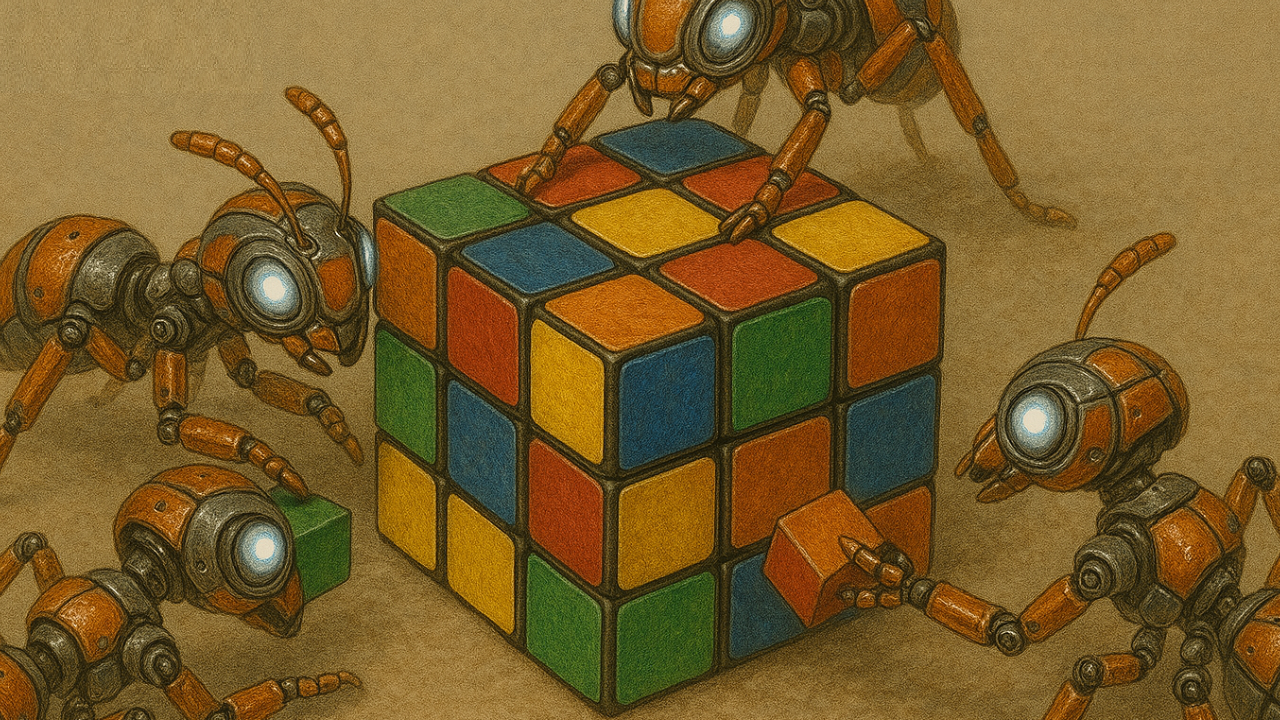
When observing nature, we find powerful inspirations for the use of AI, such as anthills and beehives. Each ant or bee performs simple tasks in a synchronized and repetitive manner. In isolation, these insects are limited, but by collaborating in large numbers, they form highly efficient systems, which we call “emergent superintelligence”.
This ability to collaborate is so impressive that it allows solving complex problems.
A great example of this is the experiment conducted by the Weizmann Institute of Science in Israel, where ants were able to solve a puzzle as a group. This collaborative behavior can be a valuable model for organizing AI systems.
2. From isolated agents to an intelligent system
Just like ants, isolated AI agents have limited capabilities. But when organized in intelligent networks, like a set of ultra-specialized robots acting in a coordinated way, they can give rise to an emergent superintelligence capable of solving challenges with efficiency and scalability.
An example of this approach is Manus, a system that brings together multiple specialized agents on distinct tasks, working in an orchestrated way towards a common goal.
The secret lies not only in the specialization of the agents but primarily in how they are coordinated.
3. Coordination: the critical success factor
True emergent intelligence only happens when we can synchronize several AI agents within a well-established set of rules. Just as in a car factory, where production involves a highly synchronized dance between humans and machines, ensuring precision, efficiency, and scale.
Without these guidelines, throwing dozens of agents at a problem without a defined collaboration strategy will likely not yield good results. Unlike ants, AI agents still do not “know how to meet” on their own, especially in situations where there are no well-defined rules.
4. AI in governmental and institutional relations: the next step
Applying AI in strategic areas such as GovRel requires more than adopting point tools. It is necessary to design flows, understand which agents should operate at each stage, and how they communicate with each other, always focusing on increasing productivity, precision, and analytical capacity.
At Sigalei, we have explored this concept to deliver increasingly intelligent and personalized solutions to our clients.
5. Reporting Agent: The revolution in your reports
Sigalei's Reporting Agent exemplifies how specialized agents can handle communication and data analysis tasks in GovRel, processing massive volumes of regulatory information to generate summaries, charts, and professional newsletters ready for email dispatch.
Unlike generic chatbots prone to hallucinations, this agent uses hybrid engines—statistical for patterns and deterministic for exact processing—along with a semantic layer featuring the company's contextual dictionary, ensuring reliable results without constant revisions.
This approach reduces complexity, elevates productivity in cross-analyses, and transforms disorganized data into actionable visual narratives, perfectly aligning with the emergent intelligence of agent networks.
Ready to structure your AI strategically? Request a demo.
____________________________________________________________________________________________
Text published on 04/09/2025 and updated on 03/18/2026 due to new features on the Sigalei platform.