
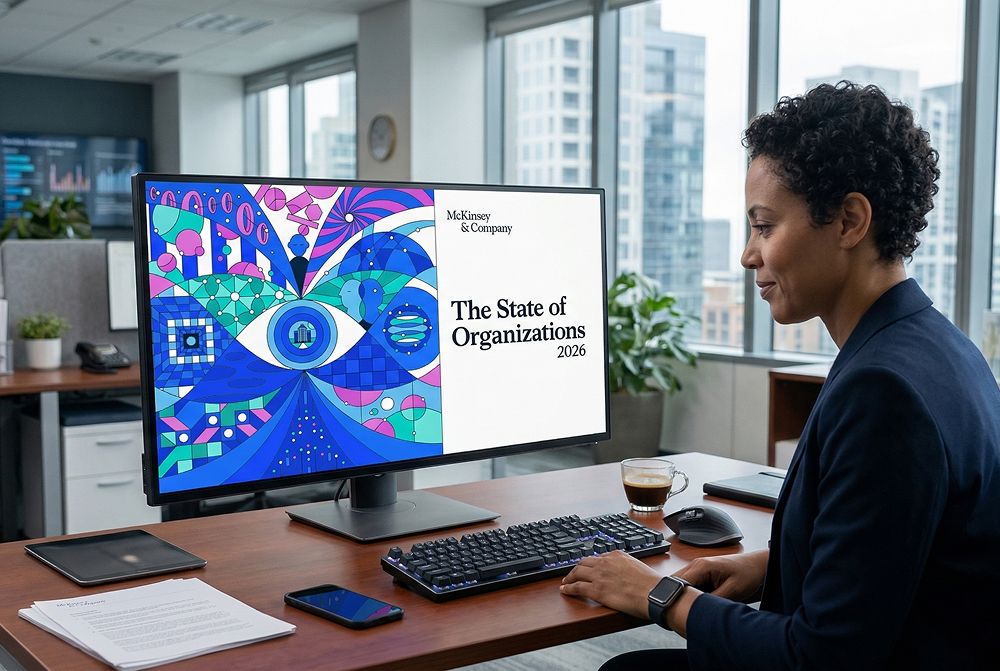
Regulatory management McKinsey 2026 trends and what to expect
The global corporate environment is traversing what the McKinsey report, “The State of Organizations 2026”, defines as “tectonic forces”: the accelerated infusion of AI, geopolitical fragmentation, and profound changes in workforce expectations.
For companies in highly regulated markets, these transformations are not merely theoretical; they daily redefine the margin of error in compliance.
In this context, regulatory management evolves from a reactive function to a continuous intelligence system, in which technology, process, and decision-making must operate in an integrated manner.
Let's now look at the main highlights of the report and how they connect to the regulatory environment.
Enjoy your reading!
1. Unlocking the AI-enabled organization
The report highlights that although 88% of organizations are experimenting with Artificial Intelligence, 81% still do not report significant gains in the bottom line. McKinsey states that success requires a “dual transformation”: both technological and organizational, rethinking how work is done in end-to-end flows.
This advancement depends less on isolated tools and more on the ability to structure the entire regulatory journey.
More mature platforms are already able to go beyond monitoring, connecting data collection, prioritization, and execution into a single flow, transforming dispersed information into actionable intelligence.
2. Collaboration between humans and AI agents
McKinsey predicts that AI should be more than a "plug-and-play"; the future belongs to collaboration between humans and AI agents acting in specific vertical flows. 55% of leaders believe that building these capabilities will bring exponential productivity gains.
In practice, this requires hybrid models. The combination of automation and structured human validation becomes essential to ensure quality and reliability, especially in regulatory contexts.
Approaches with multiple layers of screening reduce noise and direct teams' attention to what truly requires critical analysis.
And speaking of AI agents, read our article The emerging intelligence of agents: how to strategically structure AI in regulatory affairs.
3. From structure to flow: the next frontier of productivity
Two-thirds of executives consider their organizations excessively complex and inefficient. McKinsey suggests that stagnant productivity will only be overcome by shifting the focus from structure (organizational charts) to workflow, unifying processes, and eliminating silos.
This challenge is evident in compliance, where fragmented routines between emails, spreadsheets, and isolated documents still predominate.
The trend is the replacement of this model by standardized and traceable flows that connect impact, assignees, tasks, deadlines, and evidence in a single environment, reducing operational failures and increasing predictability.
Also check out the article "If the spreadsheet dies, we die with it”: The hidden dangers of manual processes in Industry 4.0.
4. Resilience in a fragmented geopolitical context
Another interesting piece of data is that 72% of leaders report that geopolitical uncertainties and regulatory changes have a notable impact on their operations. Here, the report emphasizes the need for deep flexibility to anticipate risks and reallocate resources quickly.
In this scenario, comprehensive and continuous monitoring capabilities take center stage.
Better prepared organizations already operate with broad coverage of regulatory sources and manage to identify changes in advance, quickly distributing the impacts and staying ahead of formal requirements.
And since the subject is regulatory change, it's worth checking out our article How to overcome the challenges of the EUDR using AI.
5. The human factor in performance
McKinsey emphasizes that investing in employee health and well-being is a direct performance differentiator. And this becomes extremely relevant in regulatory environments where the margin for error is minimal and any human failure can become a risk to the operation.
This is exacerbated by overly manual processes. They cause teams to report emotional exhaustion after operational errors, often resulting from failures in dispersed controls or repetitive tasks. As the volume and complexity of requirements increase, so does the need to reduce friction and bring more security to the routine.
Thus, workflow automation and responsibility organization help alleviate workers' emotional overload, make the work routine healthier, and increase process predictability.
By structuring follow-ups, deadlines, and evidence in an integrated way, modern solutions contribute to a reliable environment where the team can focus less on putting out fires and more on higher-value decisions.
6. Strategic visibility and decision
A central demand of executives today is strategic visibility. According to the report, dashboards and analytics have ceased to be just support tools and have become essential elements to track the evolution of organizational transformations in real-time.
The challenge, especially in regulatory contexts, lies in transforming complex and dispersed information into clear and actionable metrics. Without this, answering simple questions, such as the current status of compliance, can take days of manual work and still carry uncertainties.
However, with the advancement of more structured platforms, this scenario is starting to change.
The automatic consolidation of data and the translation of the regulatory universe into indicators allow managers to have immediate answers with much greater reliability. What previously required significant operational effort now happens in seconds, elevating the level of decision-making.
Also read: The use of AI in highly regulated markets.
Conclusion
The McKinsey 2026 report makes it clear: organizational agility is no longer optional. Thus, in an increasingly dynamic regulatory environment, the differentiator is the ability to transform complexity into flow, data into decisions, and obligations into strategy.
It is here that Sigalei stands out. By consolidating regulatory monitoring, intelligent prioritization, and execution into a structured and auditable flow, the platform materializes in practice the transformations pointed out by McKinsey.
More than tracking changes, it allows anticipating impacts, organizing responses, and bringing predictability to an historically reactive area, positioning compliance as a strategic lever within organizations.
Want to know more about Sigalei? Read: Why choose Sigalei? The convergence of AI, governance, and the next frontier of productivity.