
The changes and innovations happening in the public sector seek to improve customer service and also affect the daily life of the institutional and governmental relations professional.
Understand in this article written by partners from Equalitas UFMG Jr., what Digital Government is and how Brazil is advancing in this project that involves public policy, public administration, innovation, technology, digitalization, data, transparency and optimization of services and the functioning of the public sector.
What is Digital Government?
Currently we are going through the 4th Industrial Revolution. And transformations are not limited to industries and production modes; in fact, such changes occur in society as a whole. At the end of the 20th century, new technologies began to popularize: the internet, computers and phones, uses of software and hardware, evolved over the years and reached a status of greater popularization some years after their inventions.
Thought for the context of private initiative and personal use, due to the various benefits brought related to facilities of communication and service provision, process improvement, gain of efficiency and effectiveness in decision-making, these technologies began to have great appeal so that they were introduced also in public administration. It is in this context that the idea of Digital Government arises.
Initially, the concept of Digital Government referred to the adoption of technological solutions for gains in efficiency, speed and precision in the execution of management processes that are behind the functioning of the public machine. However, currently, the definition of digital government expands both to the adoption of tools, practices and solutions aiming at the efficient delivery of public services, as well as the interaction between society and the State through digital channels.
It is also important to mention that digital government goes much beyond the adaptation of physical processes to the digital environment, but, rather, it refers to the search for ways to provide public services efficiently and with greater responsiveness, ensuring transparency and interaction between government and society.
The interaction provided by digital government, in turn, is called open government. Here, the idea is that citizens can actively participate in public decision-making, inspect governments and promote transparency of government actions.
Digital Government in Brazil
Given the context presented, we will address the Brazilian scenario regarding Digital Government. In the last century, small modernization measures were adopted in the public sector, with emphasis on the years of fiscal crisis. From the 2000s, the Brazilian government began to plan and implement various public policies to optimize its routine activities and also to simplify and expand the provision of public services.
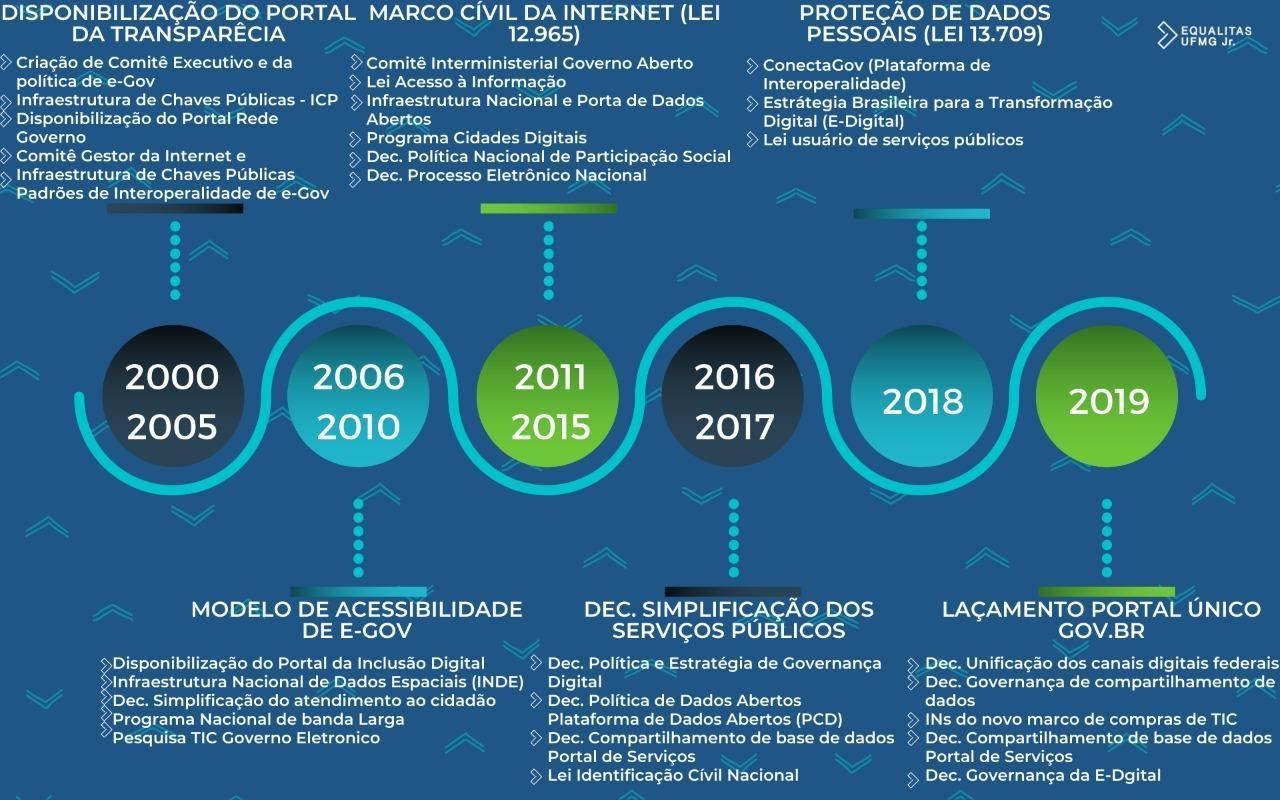
In that year, the Electronic Government Executive Committee (CEGE) was created and also approved the Electronic Government Policy for the Federal Executive Branch, both measures focused on the electronic action of the government, promotion of online access to services and implementation of digital inclusion measures.
In 2004, new guidelines were defined for the E-gov program and the Transparency Portal was also created. These actions aimed to promote the digital inclusion of the population, knowledge management and integrated governance.
In 2016, three important Decrees were published. The first, Decree No. 8.638/2016 instituted the Digital Governance Policy, the second, Decree No. 8.777/2016 was published in May and instituted the Open Data Policy of the Federal Executive Branch and finally, the third, Decree No. 8.936/2016 instituted the Digital Citizenship Platform.
Below it is possible to observe the history of events and milestones that contributed to the progress of Brazilian Digital Government.
Timeline - Digital Government in Brazil
Finally, in March 2021, Federal Law No. 14.129 was sanctioned, which provides for principles, rules and instruments for increasing the efficiency of public administration, especially through debureaucratization, innovation, digital transformation and citizen participation. The law originates from Bill No. 317/2021, authored by Federal Deputy Alessandro Molon - PSB/RJ.
In practice, Law No. 14.129, of March 29, 2021, aims to place the citizen at the center of public service demand. Thinking about public management from a collaborative and participatory point of view is not only a trend, but a necessity.
This fact is confirmed by research from the Regional Center of Studies for the Development of the Information Society (Cetic.br), linked to the Internet Steering Committee in Brazil (CGI.br). According to research data, in 2020, 54% of respondents aged 16 or older stated they had used the internet to perform some public service.
In another survey conducted by the Inter-American Development Bank (IDB), 60% of respondents said they prefer service via website, app or text message for public services. Furthermore, 46% reveal that the main reason for such preference is due to "time saving", making clear the desire for fewer lines, less bureaucracy and more efficiency in public services.
The Law No. 14.129/2021 also establishes a series of principles and guidelines aimed at guiding the implementation of Digital Government solutions in the public sphere:
- The elimination of formalities and requirements whose economic or social cost is superior to the risk involved;
- Debureaucratization, modernization, strengthening and simplification of the public power's relationship with society, through digital services, accessible even by mobile devices;
- Transparency in the execution of public services and monitoring of the quality of these services;
- Incentive for social participation in the control and oversight of public administration;
- Interoperability of systems and promotion of open data.
Santa Catarina: examples of the advancement of Digital Government in Brazil
Moving to a more in-depth analysis of technological advances in public management, the State of Santa Catarina (SC) stands out as a good example of this advancement in Brazil.
In recent years, the State has been saving millions of reais by reducing the exacerbated use of paper, as Santa Catarina has 100% digital administrative process steps, working with more agility and speed.
As a result of the State Government's efforts, we have the City of Pomerode. In the Municipality it is possible to find the mapping of all the City Hall's service processes in the cloud. The citizen then can be unconcerned about traveling to public agencies, facing lines and delays in service, as they easily solve their problems through the platforms the municipality itself provides.
The State Government, following the example of Pomerode, has been focusing its efforts on taking all services that can be carried out digitally to the citizen by the end of 2022.
In order to assist municipal managers, the Santa Catarina State Innovation Laboratory - NIDUS, published a Practical Guide for Digital Transformation in Santa Catarina Municipalities. The work contains important information about the theme, in addition to citing the step-by-step for implementing these measures.
______________________________________________________________________________________________________________
References
BRAZIL. Law No. 14.129, of March 21, 2021. Provides for principles, rules and instruments for Digital Government and for increasing public efficiency and amends Law No. 7.116, of August 29, 1983, Law No. 12.527, of November 18, 2011 (Access to Information Law), Law No. 12.682, of July 9, 2012, and Law No. 13.460, of June 26, 2017. Official Gazette of the Union: section 1, Brasília, DF, year 200, v. 60, n. 1, p. 3, March 30, 2021.
COLAB. 2021. Digital Government Law: How to bring your city into a new era.
IPM Sistemas. 2021. Digital Government: what it is and its importance for public management.
CETIC/Regional Center of Studies for the Development of the Information Society under the auspices of UNESCO, 2020. TIC Electronic Government: research on the use of information and communication technologies in the Brazilian public sector in 2019.
Inter-American Development Bank (IDB). 2021. Digital Transformation of Brazilian Governments.
______________________________________________________________________________________________________________
Currently, digital government services are realities in all spheres of government. With the aim of qualifying these services and improving such practices, Equalitas UFMG Jr. has products and services designed exclusively to support public power in improving its initiatives and service offerings to the population. To learn more, visit the Equalitas website
______________________________________________________________________________________________________________
Political knowledge for organizations
Sigalei transforms data into political knowledge for governmental relations. Improve the monitoring of bills, the Official Gazette of the Union and simplify the Management and Mapping of Themes and Stakeholders in your organization. Click here and talk to our team to learn about the solutions.