

Key points of the article:
• In general, scientific societies are less effective in advocacy than other organized groups in society, which are able to see their interests represented in policies more effectively.
• Evidence has been put to the test all the time, and investment in research has been reduced over time.
• Scientific societies can benefit greatly by positioning themselves in a more structured way as actors in the political arena.
• They already possess the capacity for network organization and mobilization of support from other societies. It is valid that they understand a little more about the tools for advocacy work and reflect on the need to have professionals dedicated to this internally.
Policies aim to find answers to public problems that are identified as such on the governmental agenda. What symptoms of a social problem constitute the starting point for identifying its existence and the need for a policy? Some social issues do not give rise to policies because they are often invisible or poorly communicated. On the other hand, many groups advocating for increased resources for their areas and succeeding in their efforts have professionals dedicated to making this need known to public agents, those responsible for budget decisions, among others.
These premises are valid for many different sectors but deserve closer attention in the case of scientific societies. In the book “The Scientific Attitude” (MIT Press, 2019), researcher Lee McIntyre discusses that attacks on science have become increasingly common, with daily examples such as flat earth theories, climate change denial, questioning of evolutionary theory, historical revisionism, among many others. In these discussions, there is an apparent sense of inability to combat movements of denialists, pseudoscientists, and ideologically driven skeptics, who have managed to mobilize followers and cause harm to collective life, such as anti-vaccine movements. The author argues that part of this occurs due to the scientists' own responsibility, as they are not accustomed to defending the results of their research or communicating science clearly, which ends up contributing to certain anti-science groups gaining a voice in society and the political space.
In a scenario of distortion of evidence and low investment in science and research, with qualified professionals being “expelled” from the country due to a lack of internal opportunities, with negative consequences for national development, innovation, productivity, and Brazil's competitiveness compared to other nations, we can ask the following questions: how much of the dismantling of science goes through the low representation of scientific institutions in governmental discussion and decision-making spaces? How many demonstrations of the misuse of evidence in decision-making, or the strangulation of funding for research, could be avoided if professional and scientific societies had greater representation in the political scenario?
Science and advocacy
The budget dedicated to funding certain activities such as research depends above all on decisions in the Legislative Branch, which, in turn, need to understand the value of research for society. Evidence is fundamental for the recognition of a problem and the insertion of the theme into the public agenda, but it is not the only element. Various mechanisms of knowledge translation attempt to make the use of evidence in public policy more systematized by managers, but the strength of groups in society is central for this problem to gain visibility and be recognized as such.
Various professional associations organize themselves within their groups, at congresses, to discuss produced evidence, but how many have professionals with knowledge in advocacy to sustain the representation of these discussions in the political arena? How can we guarantee that the relevance of what is being debated there is taken into account by decision-makers and ultimately transforms into a policy capable of solving identified problems?
It is undeniable that the press and media dissemination are still relevant ways to guarantee visibility, but political advocacy requires organization, knowledge of institutions and the decision-making process, an understanding of the interests and motivations of political and public agents, monitoring of the discussion, the public agenda, and the movements of all actors that make up the political arena.
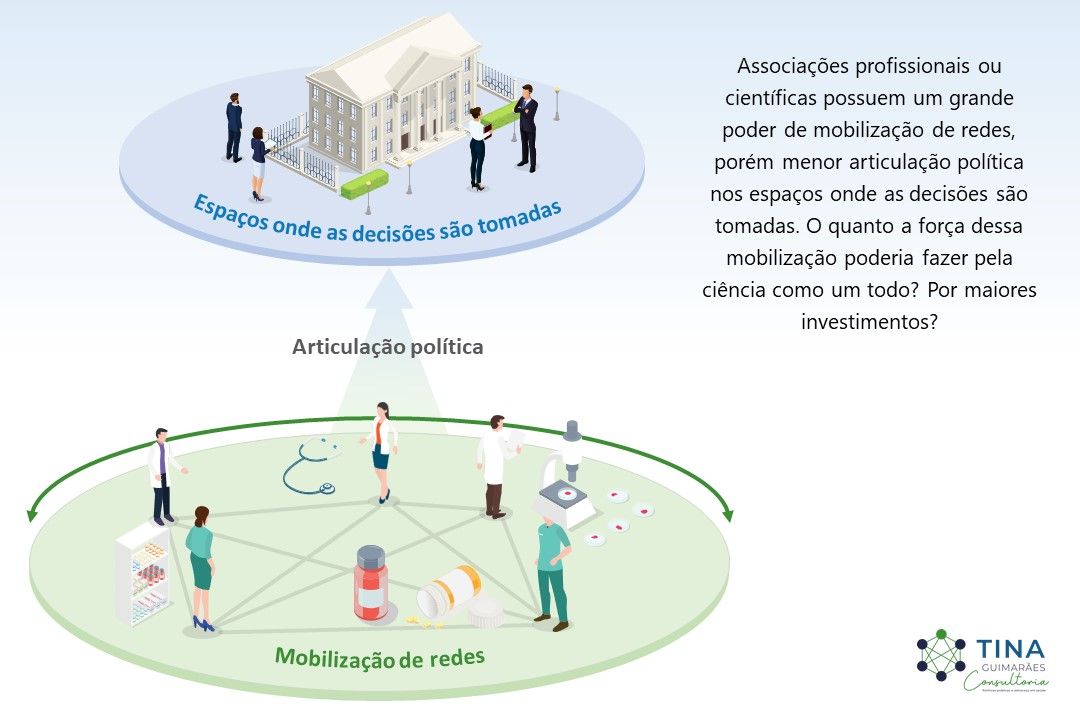
Scientific entities or science professionals engage in advocacy efforts in various ways, for example, through government advisory committees or institutes (especially from the Executive Branch), or through open letters and official positioning signed by scientific collectives. The mobilization capacity of scientific associations in these positionings is well-known, ensuring network strength, but political articulation efforts are less common, yet also necessary so that their demands are internalized by public agents, including with the support of other actors from organized civil society. Why not refine this mobilization capacity, transforming it into a more targeted advocacy effort?
In the United States, there is greater recognition of the importance of making members of the Legislative Branch understand more about science. Some professional societies, for example, foster programs where a scientist member of the society participates in training in congressional offices.
In Brazil, we are still at an earlier stage of maturity, but there are initiatives by the Legislature itself, such as the Parliamentary Action Workshop (Oficina de Atuação do Parlamento) at the Chamber of Deputies in Brasília, which allow groups in society – including scientific associations – to understand the functioning of the Legislative Branch, its role, types of communication channels of the Chamber of Deputies with the population, and tools to monitor and participate in the law-making process. This has, in fact, been a channel heavily used by other organized groups in society as a basic instrument for knowledge in advocacy work, a resource that can be better utilized by scientific societies.
We are living in an appropriate moment to reflect on the need for greater articulation and mobilization of scientific societies. This mobilization requires recognizing that it is necessary to participate in decision-making spaces and the need to include advocacy activities in their structures. This also involves promoting internal training to understand the mechanisms of politics and public policies, understanding what tools can be used for more active advocacy work, and discussing the importance and viability of an exclusive government relations professional. Otherwise, we will continue talking only to ourselves, to those who already have a high understanding of the importance of science, the need for investment in research, and the use of evidence in decision-making, but with low decision-making power in the political sphere.