
The challenges of the EUDR: How can AI help your company?
Operating in highly regulated sectors, such as agribusiness, has always carried an extra weight: compliance is not just a bureaucratic obligation, but the guarantee of business continuity. And now an additional factor emerges, it will be necessary to deal with the challenges of the EUDR (European Union Deforestation Regulation), requiring organizations to have rigorous control over their supply chains and proof of sustainable practices.
The good news is that artificial intelligence can help you with this task. It ceases to be a mere tool and assumes a central role: supporting compliance management with precision, agility, and complete traceability.
Want to better understand how this can work in your company? Follow this article.
1. What is the EUDR?
The regulation, adopted in 2023, aims to reduce greenhouse gas emissions and biodiversity loss, encouraging the consumption of products "not associated with deforestation" and reducing the impact of the European Union (EU) on deforestation and forest degradation worldwide.
Thus, for companies exporting to Europe, the EUDR represents a significant increase in the volume of documents and evidence required. In regulated sectors, the margin for error is minimal, and failures can result in severe fines, license suspensions, and irreparable damage to reputation.
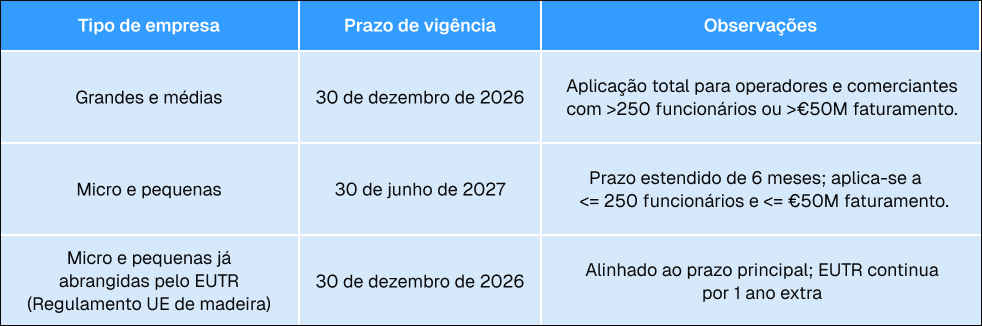
Initially, the rules would begin to take effect on December 30, 2025, but the European Parliament approved the postponement of the implementation of the EUDR. The new deadlines are as follows:
2. What are the EUDR challenges for Brazilian companies?
The impact of the EUDR on Brazilian companies, especially those in the agribusiness, food, and pulp sectors, is profound and transforms environmental compliance into a critical factor for business continuity.
Below are some of the main EUDR challenges for affected Brazilian companies.
2.1. Increase in operational and compliance costs
Compliance becomes a permanent cost center. Companies in regulated sectors spend, on average, US$ 12,800 per employee annually to maintain their legal status.
For the Brazilian exporter, this involves inevitable investments in third-party audits, technological monitoring, and detailed reporting, regardless of whether revenue is high or low.
2.2. Excessive documentation burden and traceability
Regulatory agencies do not just take the company's word for it; they demand documentary evidence of each step. In the case of the EUDR, this requires Brazilian companies to maintain detailed records of:
- Origin of raw material: documentation on what was sent, how it was handled, and who transported it.
- Evidence trail: a complete chain linking the regulatory requirement to the proof of execution (such as geolocation and certificates). This need for proof creates operational friction that slows down processes and requires each transaction to have more steps than in unregulated markets.
2.3. Risks of sanctions and reputational damage
Non-compliance can generate consequences that outweigh years of profit. Risks for Brazilian companies include:
- Million-dollar fines: heavy financial penalties applied by regulatory bodies.
- Interruption of exports: suspension of licenses or closure of markets (operational suspension).
- Brand damage: non-compliance scandals can lead to drops in share prices and loss of trust from international investors.
3. Why is "Excel + Email" no longer enough?
Many organizations still try to manage complex requirements using generic tools, creating immense operational fragility. In the context of the EUDR, relying on spreadsheets and emails brings critical risks, such as:
- Loss of corporate memory: high employee turnover causes the history of decisions and evidence saved in individual emails to be lost, forcing the team to rebuild contexts from scratch with each new audit.
- Friction between areas: EUDR compliance is cross-functional. The problem is not the complexity of the norm itself, but the dependence on multiple stakeholders and the difficulty of managing dozens of action plans branched across different departments.
- Data bottleneck: when control resides in a central spreadsheet, any error or loss of the file can mean the total collapse of the department's governance.
- Traceability difficulty: regulatory bodies require documentary evidence of each step. Without a centralized repository, gathering this evidence for an audit can take days of exhausting work.
4. How can Artificial Intelligence be your ally in compliance?
Overcoming the challenges of the EUDR goes beyond goodwill: it requires precise and efficient mastery of regulatory rules. This expertise not only creates competitive barriers against unprepared competitors, but also strengthens the trust of investors and clients who value reliability over price.
Regulated sectors demand operational resilience, not inefficient processes. The recent postponement of the EUDR deadlines, now December 30, 2025, for large companies and June 30, 2026, for micro and small companies, represents a strategic window to migrate from a reactive posture to proactive and intelligent management.
In this scenario, AI tools replace the chaos of spreadsheets and emails with integrated and automated systems. They transform regulatory obligations into competitive advantages, with the following main features:
- Norms monitoring and alerts: real-time tracking of regulatory changes from the Executive, Legislative, and national/international bodies, with personalized notifications that prevent surprises and ensure agility in response.
- Compliance management: automatic correlation of adherence evidence, simplifying audit preparation and proof of compliance to regulators, drastically reducing analysis time.
- Centralized repository: single and always up-to-date storage of all regulatory documents, eliminating dispersion in shared folders or emails and ensuring complete traceability for any future consultation.
- Workflow automation: intelligent assignment of tasks between internal and external teams, automatic sending of deadline reminders, and structured data collection, optimizing the flow of regulatory obligations without human errors.
- Regulatory analysis with AI: creation of intelligent agents that assess the adherence of varied documents, such as marketing materials, technical reports, or contracts, to current standards, identifying risks in minutes.
- Document generation and process monitoring: automation of customized report production and continuous tracking of administrative processes in government portals (like SEI), integrating everything into a unified dashboard of risks and actions.
With these capabilities, AI is not just a technical tool, but a strategic partner that elevates compliance from an operational cost to a market differentiator. Companies that adopt this approach gain efficiency, reduce potential fines, and position themselves as leaders in regulatory sustainability.
Want to know more about the subject? Read our article The use of AI in highly regulated markets and see how AI reduces operational risks, automates processes, and increases team efficiency.
5. Take control and prepare for the challenges of the EUDR
Take control of your regulatory workflow now, don't wait for the EUDR deadlines to transform your governance. With the right technology, compliance ceases to be a burden and becomes your company's strategic superpower.
Request your Sigalei demonstration and transform compliance into your strategic superpower.