Programs, public policies, the functioning of public administration, and even economic sectors have undergone intense changes, and smart cities are part of these changes.
Do you understand how GR can be impacted by this topic?
See in this article what these changes are and what they bring that could alter the way we interact with the government.
What are Smart Cities?
In recent decades, we have started to live in a new Technological Era and Digital Revolution with the emergence of thousands of technologies and innovative ideas in various sectors of society. Companies have changed their ways of selling, producing, and delivering their products, just as citizens have changed their ways of living and consuming.
In the public sector and in the management of Municipalities, this process is developing at a slow pace. Several countries and cities around the world have accompanied and adapted more quickly to technological changes and innovations, becoming global references, such as China, Japan, Germany, and New York. The reality in Brazil, especially regarding small and medium-sized municipalities in regions further away from urban centers, is still different and very backward, made up of cities with old infrastructure, poorly developed, and unattractive to the new trends of the technological generation.
It is in this context of development, innovation, technologies, and new ways of making, producing, and consuming that smart cities emerge, which are innovative and sustainable, and make use of technology in their planning processes with the participation of citizens. According to the European Union, Smart Cities are systems of people interacting and using energy, materials, services, and financing to catalyze economic development and the improvement of the quality of life. In other words, these cities stand out for developing economically and increasing citizens' quality of life by bringing technologies and efficiency to urban operations.
According to the Cities in Motion Index, a study that aims to evaluate the development of cities in the world, 9 dimensions are considered essential for smart cities; they are: governance, public administration, urban planning, technology, the environment, international connections, social cohesion, human capital, and the economy.
These dimensions of a smart city can be associated with the 2030 Agenda, the global agreement coordinated by the UN involving 193 countries for Sustainable Development. The Sustainable Development Goals (SDGs) present actions to tackle the main contemporary challenges such as ending extreme poverty and hunger, offering lifelong quality education for all, protecting the planet and the environment, and promoting peaceful and inclusive societies by 2030. This Agenda consists of 169 targets across 17 Sustainable Development Goals (SDGs) that are integrated and balance the three dimensions of sustainable development: economic, social, and environmental.
Thus, smart cities involve a modernization of the infrastructure and the connection with citizens in a sustainable and technological way, capable of meeting global targets, in addition to increasing the quality of life, developing the economy, and reducing inequalities. For these reasons, Smart Cities have already consolidated themselves in the global discussion on urban development and are responsible for driving a global market of technological solutions.
While emerging countries invest billions in smart projects and services for the economic growth of cities, developed countries seek to improve existing urban infrastructure to remain up-to-date and competitive. According to FGV Projetos, in order to materialize in this environment, more than half of European cities with over 100,000 inhabitants already have or are implementing initiatives to truly become Smart Cities.
Smart Cities in Brazil and Legislative Propositions
In Brazil, where 84.7% of the population lives in cities (according to 2020 IBGE data), the topic of digital transformation, the technological economy, and smart cities is already addressed and is evolving in public management, just as in the rest of the world. Over the last 5 years, approximately 110 Brazilian startups focused on solutions for Smart Cities have emerged, and currently, Bill 976/2021 is being processed in the Chamber of Deputies, which, even in a pandemic context, according to the Sigalei Thermometer is at a temperature of 7.7, indicating that the topic is emerging and important for the Legislative Branch and the debates are heated.
PL 976/2021, authored by Federal Deputy José Priante (MDB/PA), was presented on 03/19/2021 and proposes the institution of the National Smart Cities Policy (PNCI), aiming at improving the quality of life of city dwellers, and provides for the principles and guidelines that will guide it, its objectives, the actions to be carried out, as well as the resources to be allocated.
The Civil Society also heats up the topic, even with projects, as is the case of the Smart and Human Cities Networks, whose purpose is to present a Brazilian concept of what a smart city is, encourage municipalities to join the project, and effectively implement them.
Regarding the smart cities already in development in Brazil, the 2021 Connected Smart Cities Ranking [1] indicated that São Paulo (SP), Florianópolis (SC), and Curitiba (PR) are, respectively, the smartest Brazilian cities in a ranking of 100 cities. Taking Curitiba as an example, the city stands out for its aptitude in technology, industry, public Wi-Fi spots throughout the city, use of applications that offer online services, efficiency in urban planning, attracting tourists, and generating income. The main reason for the success of the capital of Paraná in this axis is the Vale do Pinhão project, which aims to strengthen and enhance the innovation environment through entrepreneurship, creative economy, and technology to transform Curitiba into an increasingly smarter city. Faced with these projects, several public policies emerged, such as the regulation of the innovation law, reducing the bureaucracy of opening businesses, expanding actions to revitalize urban areas (such as the Face of the City and the new Zoning Law), in addition to tax incentives for companies that invest in technology and innovation.
Challenges for the development of Smart Cities in Brazil
We realize, therefore, that various public policies are emerging in Brazilian municipalities in general. However, even with the evident advancement of the model, there are still several necessary points for its proper materialization.
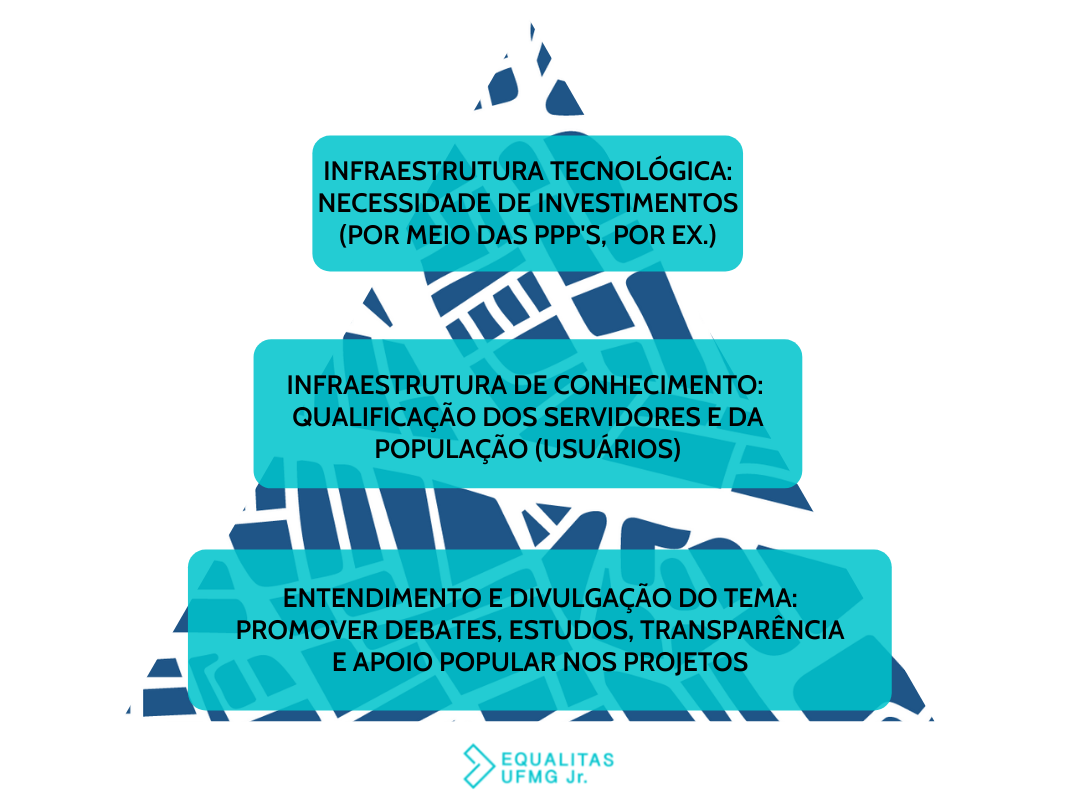
As shown in the image above, some conditions are necessary for the construction of smart cities. The basis of the major obstacles lies in the divergence between citizens (especially public entities) and technologies, that is, the realities of the managers and the population do not converge on the topic, breaking with the principle that “Smart cities demand smart citizens”. This context not only delays the creation of initiatives but also those that are already under development, as it reflects, for example, the precariousness of the dialogue between city managers and private or third-sector companies that provide services.
Another obstacle is the great constitutional responsibility of the Municipalities to expand the supply and scope of public services in the areas of health, education, social assistance, mobility, and, more recently, public security. Municipal budgets prove to be insufficient for high investments in infrastructure, technology, digitalization, and improvements in service provision. Furthermore, there is still a low level of aggregation of information and communication technologies and the use of data in processes and services, because public management continues to slowly perceive them as strategic, and this is a primary factor for smart cities.
With this, in common scenarios of few resources and little awareness and training of managers and even citizens on the subject, these become the barriers that make it difficult to envision some Brazilian cities becoming smart in the short term. For municipal management to advance in smart projects, it is essential that the leadership of the Municipalities develops joint work with other spheres of public administration, companies, universities, and citizens. Regarding the lack of resources, Public-Private Partnerships (PPPs) have increasingly become an alternative to make infrastructure projects and technological improvements viable, even in small and medium-sized municipalities.
Finally, smart cities prove to be agents of transformation for both the future and the present, and even if there are challenges in their implementation, the long-term benefits justify the investments. In Brazil, it is believed that the lack of a defined concept of what the Brazilian smart city would be may still be one of the reasons for shelving promising projects; however, the advancement of the theme is notable, and after all, in the meeting of concepts, truly smart cities are those that promote the improvement of the lives of their citizens.
______________________________________________________________________________________________________________
References
[1] 2021 Connected Smart Cities Ranking
Smart Cities and Communications
Smart and Sustainable Cities: Conceptual and Regulatory Challenges
Law No. 14,129/2021 - Digital government law
LOURES, Rodrigo da Rocha. Innovative cities. ComCiência, Campinas, n. 125, Feb. 2011 .
PL 976/2021 - National Smart Cities Policy (PNCI)
Smart cities - digital transformation of cities
______________________________________________________________________________________________________________
This article was written in partnership with Equalitas UFMG Jr, a Junior Consultancy of the Public Management course at the Federal University of Minas Gerais. Learn more about Equalitas by clicking here
______________________________________________________________________________________________________________
Political knowledge for organizations
Sigalei transforms data into political knowledge for government relations. Improve the monitoring of bills, the Official Gazette of the Union, and simplify the Management and Mapping of Themes and Stakeholders in your organization. Click here and talk to our team to learn about the solutions.