
The monitoring process is one of the challenges of Institutional and Governmental Relations (IGR or GovRel) work.
Even with the facilities of the internet, it is not simple to simultaneously track the evolution of strategic issues. This is because search results can generate what a huge volume of results without hierarchy – what we call “high noise”.
And the noise intensifies even more in a scenario of constant changes in the Three Powers (Executive, Legislative, and Judiciary) and the insane publication of news in the media and statements from relevant actors of public opinion on social networks.
With so much “messy” information, it becomes much more complex to organize, in a priority matrix, the risks and opportunities.
This leads us to a key question:
How to overcome the monitoring challenge by building a reliable and resilient process, capable of identifying these critical signals that denote risks and opportunities to feed the IGR process?
This has been exactly the purpose guiding Sigalei.
Over the last few years, we have developed and refined a technology supported by a methodology tuned to IGR processes.
And it is exactly a summary of this content that we bring in this new article with some practical tips:
1. The importance of filters
First of all, good news: it is not necessary to collect 100% of the information, no!
The priority is to identify the main movements that occur within each issue of interest to the organization – a bill that changes the regulatory framework, for example.
In other words, the fundamental thing is to capture the really important movements to fuel good decision making.
Therefore, the solution passes through the creation of filters that must be applied to the immense mass of data.
The trick is that the filters provide visibility of the movements of stakeholders important to your cause – from ministers to second and third tier officials, from senators to deputies and councilors, from judges to prosecutors, from directors of regulatory agencies to competing companies, from representatives of supporting entities to detractors, among many others.
The ideal is that these movements appear in maximum resolution image, correct?
But... what are these filters?
It depends!
To configure the filters, keep in mind that there are no absolute filters valid for any business.
Everything depends, of course, on the objectives of who will receive this information – that is, the strategists, actuators, and directors of the organization.
2. A good way: monitoring according to public policy flow
Contributing to the construction of policies is the main delivery of IGR to its organization, as well defined by the Professor of MBA Institutional Relations and Public Policies at Ibmec, Eduardo Galvão.
Therefore, this guideline must guide the creation of filters.
These must be able to reveal the movements of public policies that are critical to the issues of interest to the organization.
Depending on the model, a public policy usually consists of 4 or 5 main phases.
According to the model described in this document published by the World Bank, “The Practice of Policy-Making in the OECD: Ideas for Latin America”, there are basically four phases:
. Public Policy Identification;
. Public Policy Decisions;
. Program Implementation;
. Evaluation of Implemented Programs.
Therefore, it is of paramount importance that the filters reveal the critical movements related to each of these phases of public policy formulation.
3. Seven questions to capture critical movements in public policies
Everything becomes much less complex when starting with the following set of questions:
a) What are the movements in society, in the political class, and in the technical staff that reveal that stakeholders are worrying about problems or social desires that do not yet have public policies to solve them?
b) And what movements, among the political class and/or technical staff, point to a process of internalizing these problems and/or desires into the public policy construction process?
c) Among these same stakeholders, what movements indicate that solutions have been prioritized and that a deliberation and decision process is occurring?
d) In the government technical staff, what actions reveal the deployment and execution of programs derived from the outlined public policies?
e) Finally, what are the movements of government actors that allow revealing questions and measurements of the results achieved with the implemented public policies?
To answer such questions, it is necessary to cross with two other categories of information:
f) What are the main types of movements that denote the evolution of issues in each of the phases of the public policy construction process?
g) What is the organization's business structure?
The basis of the methodology lies in answering questions (f) and (g) under the context of the initial questions.
4. How to apply the methodology in a practical way in 6 steps?
Good knowledge is applied knowledge.
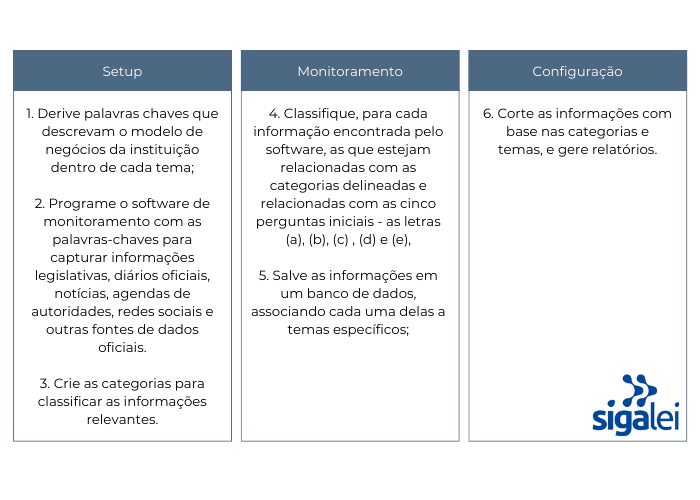
To establish the filters, therefore, we need to follow six steps divided into three stages.
Here is a summary:
*
In a very summarized way, this methodology helps a lot in a good analysis of risks and opportunities. And this is gold dust for a more assertive strategy in Institutional and Governmental Relations (IGR or GovRel).
Here at Sigalei we have monitoring and analysis solutions.
We are certain that we can help you boost your organization's IGR performance.
Just send me a message. It will be a pleasure to talk to you!
I'm waiting for you!