Environment in public debate
The topic of the environment is extremely relevant at a time when we believe we have reached a “point of no return” regarding global warming (DW, 2021). The concern with environmental impacts and the damage they will cause in the future is a growing debate in society and the demand for increasingly larger public policies.
Therefore, the environmental issue in public debate is present, mainly in a context of great international and national relevance for Brazil, due to COP-26 and the approval of the flexibilization of environmental laws by the Chamber (AGÊNCIA CÂMARA DE NOTÍCIAS, 2021). Based on this, Bill 3729/2004 was chosen for analysis, as it has recently gained great relevance and has been the center of public debate since May 2021, since it presents a movement contrary to an agenda that has been growing in Brazil, that of the environment.
PL 3729/2004 and its impact on the public agenda
The bill 3729/2004, put on the agenda in 2004 by Deputy Luciano Zica (PT/SP) and others, and, later restructured in 2019, was approved by the Chamber of Deputies in May 2021 since it was processing under an urgency regime. This regime was approved in 2017 with the justification that the topic of licensing is one of the “least understood in the country”, and that the entire licensing process, at the time, had excessive bureaucracy. Given this conjuncture of urgency, as mentioned previously, the PL was approved in the Chamber of Deputies, however, it is still awaiting its approval in the Senate (SIGALEI, 2021).
Project 3729/2004, has as its main motivation, according to the Professor of Sanitation and Environmental Licensing at UFMG, Luciano dos Santos Rodrigues, a very great pressure from ruralists and the current government (which promised to make licensing more flexible during the campaign). The approval or not of this PL is a very important debate for stakeholders such as enterprises and environmental defense organizations. We can infer, then, that the debate regarding the effects of this bill is recurring on the agenda of interest groups and on the public agenda of environmental issues.
Legislative Process of PL 3729/2004
During its 17 years of processing, PL 3729/2004 has already gone several times through the Plenary, the Steering Committee, Permanent Committees, and non-permanent ones. According to the Chamber of Deputies website (2021), first, on 06/08/2004 the PL went to the Plenary for presentation, and its last processing to date was on 05/21/2021 also in the Plenary, however this time for the presentation of the Vote Declaration of Deputy Aelton Freitas (PL/MG) and Deputy Lucas Gonzales (NOVO/MG).
Below we can see the processing of the PL in more detail:
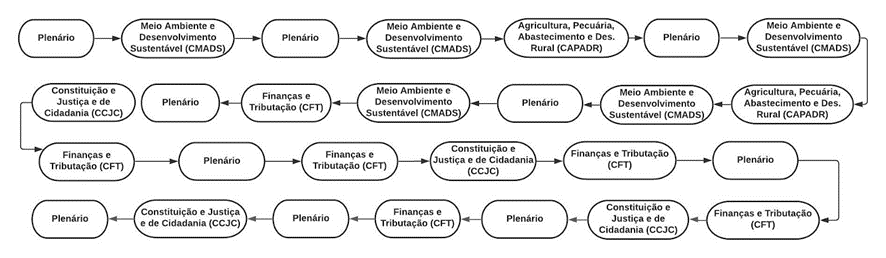
A PL does not have an average time to be granted or denied, however, PL 3729/04 has been in negotiations since 2004 and was marked as "urgent" on the processing file of the Chamber of Deputies. Its latest legislative actions occurred in May 2021, with the approval of amendments by the CMADS, CAPADR, and CFT. Finally, the base text of the project was approved by the Chamber in May 2021, with 300 votes in favor and 122 against; and it is currently waiting to be analyzed and approved by the Senate (CHAMBER OF DEPUTIES)
Analysis of stakeholders and prospect of progress in 2022
As already stated, PL 3729/2004 was under an urgency character in the Chamber of Deputies, and this scenario generated less discussion about the project with society, as well as reduced the times the PL was put to a vote in the Chamber committees. In addition, in October 2019, Kim Kataguiri (DEM-SP) presented a new version of the PL and some actors from society who fight in favor of the environment and who already criticized the project previously, again disapproved of the changes and the subsequent lack of necessary public hearings, since, with the urgency character, it made the debate and its expansion with civil society about the new version of the PL even more difficult (CÂMARA DOS DEPUTADOS, 2019; EESC/USP, 2019; WFF, 2019), which was approved in the Plenary of the Chamber in May 2021.
Thus, when analyzing the stakeholders of this PL, it was identified that there was little engagement of the population and little disclosure in traditional media, and, consequently, the discussions about the PL were “niche”, that is, the debate was occurring only among those who are really interested in the subject or who, negatively or positively, would be directly affected by the consequences of the PL. Therefore, the main stakeholders of PL 3729/2004 are, as opponents, NGOs, Associations, Institutes and Foundations, like Greenpeace, the Brazilian Association of Members of the Public Ministry of the Environment, the Socioenvironmental Institute and the Brazilian Foundation for Sustainable Development, in addition to the quilombolas and the riverside and indigenous communities; and as supporters the FEBRABAN, the CNI and the CNA, and, finally, Deputy Kim Kataguiri (DEM-SP).
The opponents of PL 3729/2004 have their positions based mainly on the environmental issue and the possible damage the PL could cause (ANTUNES, 2021); while the supporters believe and defend that the approval of the new general licensing law project will provide Brazil with more jobs, since, due to less bureaucracy, it would attract more investments and infrastructure (CRUZ, 2020; FERREIRA et al, 2021); SIQUEIRA, 2021).
Therefore, when evaluating the conjuncture of approval of PL 3729/2004 in the Chamber, it was identified that there was a great pressure from the CNA, CNI, FEBRABAN, and other business sectors made from lobbying. Thus, as much as the opposition of the PL defended that the project be taken off the agenda, the probability was very low, because according to Deputy Nilto Tatto (PT-SP) “they have the votes to pass the project the way they want” (MARETTI, 2021). Thus, the supporters of the PL have more influence and resources to decide the fate of approval of the PL and, for the year 2022, when the project is waiting for its passage through the Federal Senate, the probability of also being appreciated and quickly approved is high, given that it is a subject placed as, according to Cidade (2022), a priority on the Government's environmental agenda and the majority of Senators are part of the bench that supports the approval of the PL.
This article was written by the 1st place winning group of the Sigalei-ESPM Award 6th Edition. Access the work with the complete analysis of PL 3729/2004 by clicking here
The Sigalei-ESPM Award is an initiative in partnership with the International Relations course of the Superior School of Advertising and Marketing (ESPM) that happens annually since 2019 and aims to encourage young talents in the institutional and government relations market.