
1. PL 3338/2015 - Summary: Provides for the free transfer of corpses or mortal remains of native or naturalized Brazilians, recognized as poor, who passed away abroad. (Presentation: 10/20/2015)
2. a) Detailed processing (Chamber, Senate, commissions, plenary, public hearings)
The bill deals with the free transfer of corpses or mortal remains of native or naturalized Brazilians, recognized as poor, who passed away abroad. This project was initially presented on 10/20/2015 by Deputy Geovania de Sá. The project, which is still in process, must be forwarded for analysis by the Commissions of: Foreign Relations and National Defense; Finance and Taxation; and Constitution and Justice and Citizenship.
On 10/29/2015, the project was sent to the first commission of Foreign Relations and National Defense (CREDN), Deputy Eduardo Barbosa was appointed rapporteur on this first occasion, in 2015, and also later in 2018. However, on both occasions, the project ended up being removed from the agenda because no amendments were presented, and it was only unarchived in 2019, going through a new analysis cycle, including the designation of a new rapporteur, Deputy Rubens Bueno, on 04/16/2021.
A crucial moment occurred in 2021, when a request was presented by Deputy Aécio Neves (PSDB/MG), who claimed that: "Requests the attachment of Bill No. 435/2020, authored by Deputy Alexandre Frota, to Bill No. 3,338/2015, authored by Deputy Geovania de Sá". In other words, Deputy Aécio proposed that another bill be associated with the original project, being treated jointly, as if they were a single project, in order to facilitate the analysis of both proposals. Therefore, the request was accepted and approved on this date, resulting in the redistribution of the project to other commissions, further expanding its analysis.
However, the rapporteur Rubens Bueno presented a controversial opinion in 2022, recommending the rejection of the original project and the approval of a substitute. However, the latter was not voted on due to the rapporteur's departure from the commission in 2023, ending the deadline for amendments. And a new stage began with the appointment of Deputy Arlindo Chinaglia as rapporteur, however, the project was returned again without manifestation by the rapporteur in 2024.
Therefore, currently, the project is stalled in the CREDN commission, and with this, the complexity and challenges faced in the processing of this project become evident, involving different rapporteurs, the opening and closing of deadlines for amendments, as well as requests for the attachment of other projects.
b) Identification of the main political actors involved in the processing
The author of PL 3338/2015 is Geovânia de Sá, Federal Deputy of PSDB/SC. Geovânia, a former councilwoman and Health Secretary of Criciúma, is currently in her second term as Federal Deputy, after being re-elected with over a hundred thousand votes. A member of the evangelical bench, she is known for taking a stance with conservative agendas, characterizing herself as a right-wing politician. An example of her actions that prove her political position is her vote in favor of Dilma Rousseff's impeachment and the Public Spending Ceiling PEC, but against the Labor Reform.
Besides the author, the other political actors involved in the processing of the PL in question are the presidents of the linked commissions, the rapporteurs of each one, and their parties. The proposition is subject to the approval of the Foreign Relations and National Defense (CREDN), Finance and Taxation (CFT), and Constitution and Justice and Citizenship (CCJC) Commissions, currently chaired by Lucas Redecker (PSDB/RS), Mário Negromonte (PP/BA), and Caroline de Toni (PL/SC), respectively.
Former Deputy Eduardo Barbosa, the first rapporteur of the PL, who passed away in 2023, was affiliated with the PSDB for almost 30 years, where he voted for the party in favor of agendas such as the privatizations of Eletrobrás and Correios and the institutionalization of the secret budget. While Eduardo resembled right-wing agendas more closely, Deputy Rubens Bueno, the second rapporteur of the PL, can be characterized as what became popularly known as "centrão". The member of the CIDADANIA political party is also a member of the Parliamentary Fronts for Agriculture, Mining, Industry, Democracy, and Human Rights, and historically positions himself on different agendas that sometimes strengthen the Brazilian right and sometimes the left.
Then, who assumed the rapporteurship of the PL after Rubens' departure was Arlindo Chinaglia, who began his trajectory in politics in the 1980s when he participated in the founding of the Workers' Party (PT). Unlike the other rapporteurs, Arlindo can be characterized as a leftist figure, with decisive participation in public policies of the PT government, such as Bolsa Família and Prouni. More recently, the Project introduced Deputy Dandara Tonantzin, a pedagogue, activist, and Brazilian politician affiliated with PT/MG, as the new rapporteur. Like Arlindo, Dandara is characterized as a left-wing politician.
From the perception of the positioning of the author and the rapporteurs of the Bill in question, it is possible to observe that the first actors were more conservative while the latter are more enthusiastic about agendas related to Human Rights, which could lead to a change in the future processing of the PL.
c) SigaLei Tools
SigaLei tools provide a detailed analysis of the bill, its processing, some bills that have some kind of similarity, the average number of days, or how fast it is processing in comparison with other Bills.
In the scope of Similarity, it is noted that there are 8 projects cited as slightly similar, of which five bills cite the free transfer of bodies at the inter-municipal level, all focused on the State of Mato Grosso, and two other bills cite the free transfer of bodies, the first both inter-municipally and internationally by the institution of the Interstate and International Funeral Assistance Program - PAFII, the second cites Brazilian air transport companies as the actor responsible for the interstate transfer of bodies.
The only bill understood as very similar by Sigalei is PL 3980/2012, presented by Deputy Candido Vaccarezza - PT (SP), it has exactly the same proposal as the analyzed Bill, however, it was archived by the Board of Directors of the Chamber of Deputies due to the automatic closing of the Appeal Period and had the same rapporteur as the analyzed PL, Eduardo Barbosa.
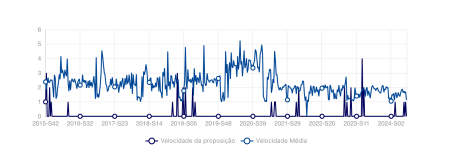
Image 1: History of processing speed
Source: SIGALEI (2024)
The processing speed was higher during the year 2015, which corresponds to the first peaks in the graph, precisely because it is the year of the presentation of the Bill. However, after April 2016, the processing, which had already slowed down, had its last movement for 2 years, being unarchived only in 2019 and analyzed again, which explains the higher peaks. The next movement of the project was in 2021, when another bill was associated with the original, which ended up being approved. In 2023, the year in which the speed reached its highest peak, above the average speed, rapporteur Eduardo Barbosa presented a rejection of the project and a substitute, in addition, a new rapporteur was appointed for the project. Overall, the processing speed was well below the average speed, which shows that the project is not of extreme urgency and interest in the chamber.
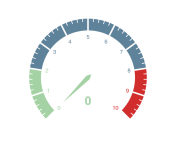
Image 2: Temperature
Source: SIGALEI (2024)
The Proposition's Temperature, which previously comprised 0, starting from 05/21/2024 became 0.6 due to a change of rapporteur in the process, which means that it is processing faster than 6% of all propositions of the same type from the same house that processed in the last 90 days. However, it returned to 0 from 05/25/2024. Thus, it is observed that the project lacks dynamism within the chamber, let alone urgency on the agenda, which indicates that the processing has not been and probably will not be fast.
3. Identification of civil society stakeholders involved in the processing
From the understanding of "Civil Society" as social actions taken up by individuals or groups that do not originate in the State, nor respond to it, we can cite the stakeholders of this nature involved in the processing of PL 3338/2015.
Firstly, we can mention Airline companies. Currently, it is customary for conventional international flights to transport mortal remains along with other passengers; for this, the Company must be in accordance with the National Health Surveillance Agency (Anvisa), its obligations, and documentation, such as a zinc urn, identity document of the deceased person and the person responsible for the dispatch, a free transit guide issued by the police station, among others. Thus, compliance with the PL in question depends on the public-private sector partnership, taking into account logistical, regulatory, and financial challenges. (PUBLICLICK)
Furthermore, as interest groups, there are Non-Governmental Organizations (NGOs) focused on defending human rights, associations, and private companies that provide legal and social support to Brazilians abroad. Such bodies participate in the debate not only to defend the interests of their causes but also contributing to the debate with their know-how, experiences, and data on the subject.
4. Scenario for the advancement or not of the bill.
When analyzing the project's progress, it appears that the last movement took place on May 21 of this year, with the appointment of a new rapporteur, Deputy Dandara, of the PT-MG. Although recent, this is a fact that results from the failure of previous rapporteurs to state their position on moving the case forward. The PL has not progressed since its inception in 2015, remaining in the Foreign Relations and National Defense Commission (CREDN). Searching the deputy's profile on her social networks, it is possible to observe that several posts were made during the week of the event, even on the day itself. However, she makes no mention of becoming the rapporteur for the project. Her agenda consists of the revision of the Quota Law, the Repeal of the New High School, the Popular Tax Reform, the Defense of Women's Rights, and the Sacred Territory, having a career focused on education. Thus, it is inferred that there is no priority on the subject of the project. (DANDARA, 2024)
It is also not possible to find recent news on the subject, raising questions about the relevance of the issue in society and the commotion generated so that there is an assiduous demand on the progress and approval of the PL.
From the aforementioned facts, it is understood that the project is in a scenario of stagnation, with no near forecast of being concluded. Even if it advances in the current commission, it would still have to pass through the Finance and Taxation Commission and the Constitution, Justice and Citizenship Commission, which is a slow process, given the duration of almost 10 years to date.
REFERENCES
BRAZILIAN TIMES. Low-income Brazilians deceased abroad could have transfer paid by the Government. Available at: <https://www.braziliantimes.com/imigracao/2015/11/20/brasileiros-de-baixa-renda-falecidos no-exterior-podero-ter-traslado-pago-pelo-governo.html>. Accessed on: May 25, 2024.
CHAMBER OF DEPUTIES. PL 3338/2015. Available at: <https://www.camara.leg.br/proposicoesWeb/fichadetramitacao?idProposicao=2023409>. Accessed on: May 25, 2024.
DANDARA. Dandara Federal Deputy. Available at: <https://todandara.com.br/>. Accessed on: May 25, 2024.
PUBLICLICK. Information on Funeral Air Transport. Available at: <https://www.funerariaecemiterio.com.br/informacoes-transporte-aereo-funerario.html>. Accessed on: May 25, 2024.