
Key messages:
• Advocacy can be defined as the process of influencing, directly or indirectly, government decision-making and the policies that affect society or specific groups. It can be exercised by individuals alone or by groups in society.
• The policy cycle in this article is divided into five stages: 1) Agenda setting, 2) Policy formulation, 3) Decision-making, 4) Implementation, and 5) Evaluation.
• An agenda can be defined as the set of issues or problems that come to the government's attention, mobilizing it to act.
• The analysis of a topic for inclusion in the governmental agenda involves the recognition and filtering of problems by public agents and is anchored in theories and approaches, i.e., it is an analytical and studied process.
• For a topic to be included in the governmental agenda, a clear definition of the problem is required, and it must have relevance for society.
• No actor has direct control over all the mechanisms that affect agenda setting, but the role of groups in society is fundamental in influencing this agenda.
• Knowledge of the policy cycle is crucial for advocacy work, to know how to act and how to take advantage of opportunities for collaboration and defense of interests, with the inclusion of topics in the agenda.
1 - Governmental agenda setting
The policy cycle approach as an ally for advocacy work
There are many definitions of the term advocacy, and there is no consensus on how best to describe the exercise of influencing public policy decisions. In general, advocacy can be defined as the process of influencing, directly or indirectly, governmental decision-making and, therefore, the policies that affect society or specific groups. Advocacy can be exercised by individuals alone or by groups in society.
Today I begin a series of five articles on understanding the policy cycle, its components, and what the fundamental elements are to work in advocacy in each of them, focusing on health policies. This content is based on the Health Policies discipline that I teach in the MBA in Health Technology Economics and Evaluation, by the Institute of Economic Research Foundation (Fipe), linked to FEA-USP. The goal is to offer elements for reflection and organization of political incidence work by groups in society interested in this topic. Although the examples are from the health area, this analysis can be used in other fields of action.
The idea with the articles is not to dwell on the detailing of concepts, but rather to focus on the importance of knowing the political process to act in this area. What are the potentialities and opportunities that this perspective can bring as an analytical tool for advocacy work by individuals or groups in society? These are the reflections I intend to bring.
But what is the policy cycle?
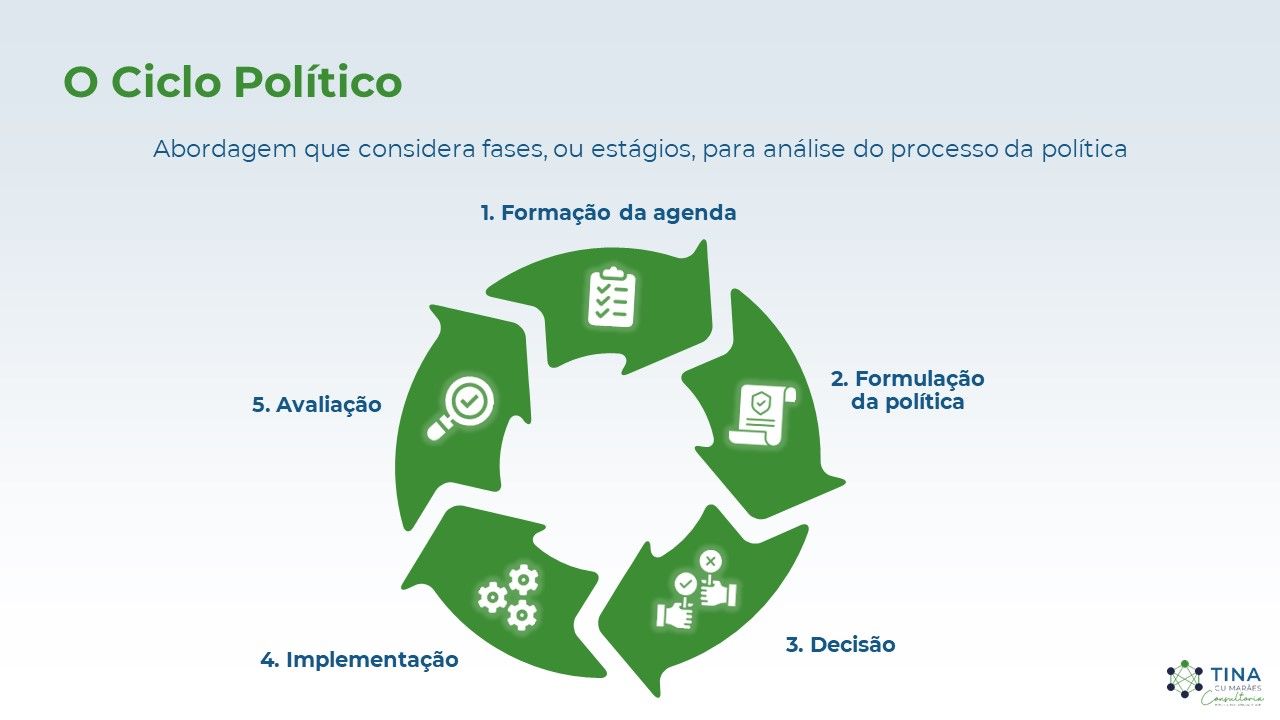
The policy cycle approach has its origins in the 1950s, in the field of analysis that considers the political process as a sequence of stages or phases. Various authors have proposed different stages for this cycle. What I will adopt here is based on one of the most commonly adopted, with five cycles described in chronological order: 1) Agenda setting, 2) Policy formulation, 3) Decision-making, 4) Implementation, and 5) Evaluation. Each article will deal with one of these components. In the following paragraphs, I detail the factors that lead to the inclusion of a topic in the governmental agenda.
Agenda setting
Although the Covid-19 subject is already exhaustive, it is undeniable that this pandemic brought to light new discussions and new opportunities to insert topics into the governmental agenda. We see the example of basic income and environmental issues relating to air pollution, among others. These themes are not new, but they have gained prominence given this reality to which we are all subjected. We can say that these topics found “windows of opportunity” to be discussed at the governmental level, mobilizing parliamentarians and society in general.
Several authors have delved into approaches and theories inspired by empirical observations to establish the mechanisms by which a given problem enters the governmental agenda. An agenda can be defined as the set of issues or problems that come to the government's attention, mobilizing it to act. This means that the agenda corresponds to the recognition and filtering of problems by public agents. To understand why some problems enter the governmental agenda, I will focus on three questions:
a) Why do some issues gain attention to the point of mobilizing action for their solution by governmental entities?
The identification of a problem is the first step towards change and the creation of a policy. But what is the problem? It is a situation that triggers a collective need, a dissatisfaction with a certain issue. The problem can draw attention due to a change in an indicator (mortality, morbidity, service utilization, among others), a lack of progress towards a certain goal, or public discontent with a certain issue, for example. In short, a problem exists when there is a difference between the current situation and what is desired.
However, there are a significant number of problems and not all are subject to public policy. The passage from the simple existence of the problem to its “political filter,” when effectively this problem enters the radar of public agents, occurs due to the severity of the problem and the extent of social mobilization and coverage it receives in the media. Therefore, the movement to insert a problem into a public agenda requires political action, encouraged by society.
b) What is the best time to include a particular topic on the agenda?
Some theories express that the government acts rationally, listing priority issues based on objective criteria, as mentioned earlier, and acting to solve these problems. A variation of this approach predicts that the government looks at the long-term horizon and the social determinants that influence the problems they need to address. In this perspective, for example, the government would respond from time to time to occasional problems that arise from long-term changes, such as population aging (and health problems arising from this aging, for example).
Another set of approaches emphasizes the importance of power and ideas, rather than the strictly rational approach posited earlier. In this perspective, what matters is how the problem is defined and posed, arousing more or less support from society so that it is recognized as more relevant than others competing for the agenda. Thus, a problem would only enter the agenda if it had high legitimacy from groups in society, viability in terms of solutions and implementation, and support from groups in society.
One of the most used approaches was proposed by Kingdon (2010), and is based on the idea that certain individuals inside or outside the government (whom he calls political “entrepreneurs”) take advantage of opportunities to include a theme on the governmental agenda. This model suggests that “windows of opportunity” open when there is a confluence of three streams:
• The problem stream: perception of the problem as a public issue requiring a solution, envisioned through indicators (objective measures), pressure from groups, or focal events (such as the aforementioned crises).
• The policy (solution) stream: like other theories, the debate around solutions to problems needs to find viability in implementation, be able to deal with future restrictions (e.g., financial), and be publicly acceptable.
• The political stream: the political stream operates separately from the previous two and represents the appropriation by public agents, whose will for change depends largely on changes in national mood or changes of government that, in general, provoke a change in the governing body of institutions.
The model points out that windows open and close quickly, and it is difficult to predict when this confluence of the three streams will occur.
Moments of crisis - such as the one we are experiencing regarding the pandemic - are a great opportunity to include certain topics on the agenda, whether direct (related to containing the epidemic) or indirect (related to the economic consequences of the epidemic, for example). In a crisis situation, government action in search of solutions is more evident. However, a crisis is not the only time to insert a topic onto the agenda. Changes in the national mood or institutional changes (alteration in the government brought about by elections) are also seen as opportunities.
However, clearly, these moments represent changes, expected or not. In most situations, though, the government is led to solve problems in “normal” situations, day-to-day, where it has to deal daily with an infinity of issues and a finitude of resources. And here I come to the aspect that I draw attention to in the article, the role of groups in society.
c) Who influences government decisions?
As mentioned earlier, the inclusion of a topic on the agenda results from the selection of various problems or issues by public agents, thus being a mechanism for filtering problems by those who make the decision. Objective conditions, such as the emergence or prominence of diseases, have higher chances of becoming policies when there is a perception of their problems, social pressure for something to be done about it, and an institutional environment for discussion. Kingdon (2010) is based on the idea that certain individuals inside or outside the government would play a crucial role in filtering these problems for public entities.
However, in general, no single actor has direct control over all the mechanisms that affect agenda-setting. An important point is that for an issue to be seen as a problem, the severity of this problem for society or population subgroups needs to be very clear and demonstrated through epidemiological, economic, and social measures. The involvement of particular actors (pressure from interest groups) and the use of media coverage to give visibility to the problem are described as some of the most successful tactics for influencing the government, combined with the choice of institutional venues/paths for the problems to be debated (e.g., legislative houses).
Furthermore, regarding the characteristics of civil society, empirical studies show that the chances of success in advocacy work are greater when the following characteristics are observed:
• High community cohesion: the degree of adherence between networks of individuals and organizations that are directly involved with the issue,
• Leadership capacity: the presence of individuals capable of uniting the community and being recognized as “champions” for the particular cause,
• Presence of guiding institutions: good coordination and effectiveness of organizations capable of leading the initiative,
• Mobilized civil society: the existence of a large base of support in society that can pressure national (and international, depending on the context) political authorities to influence the issue.
In short, understanding the policy cycle and its mechanisms is an important ally for society to know when and how to act to include topics on the agenda. In the next article in the series, I will detail the factors to be considered in formulating a policy.
Suggested bibliography:
Buse, K.; Mays, N.; Walt, G. Making Health Policy. Second edition, Open University Press, 2012.
Fischer, F.; Miller, G.; Sidney, M.S (editors). Handbook of Public Policy Analysis: theory, politics and methods. CRC Press, 2007.
Hill, M. (2014). Studying Public Policy: an international approach. 1st ed., Bristol University Press, Clifton, Bristol, 2014.
Kingdon, J.W. Agendas, alternatives, and public policies. Pearson (updated second edition), 2010.
Knoepfel, P. et al. Public policy analysis. The Policy Press, 2007.
Peters, B.G. (2015). Advanced introduction to public policy. Cheltenham: Edward Elgar. 2015.
Zahariadis, N. (Org.). Handbook of public policy and agenda setting. Cheltenham, Northapton, UK: Edward Elgar, 2016.