

Key messages:
- Until the 1970s, it was believed that a well-designed policy would guarantee successful implementation. However, it was realized that flaws were intrinsic to the implementation process, which led to the evolution of studies in the 1980s and 1990s.
- The implementation phase of a policy is critical to the success of a program because it is in this phase that most of the contact between society and the State takes place.
- The most common approaches to policy implementation are top-down and bottom-up, the first being based on centralized government decisions and the second on the active participation of local implementation actors and networking.
- Decision-making in public policies is, ultimately, a governmental decision. However, society can contribute very actively to the policy implementation process, whether by directly assisting in implementation, monitoring the process and its developments, and generating evidence to check the effectiveness of the implementation.
- It is easier to implement a law if it has good acceptance and compliance among all involved, which is why articulation with implementers (the organizational level of government) is so important.
This article is the fourth in the series on advocacy work in the policy cycle written for Sigalei. In this text, I talk about policy implementation, which corresponds to the process of transforming policy into practice or action.
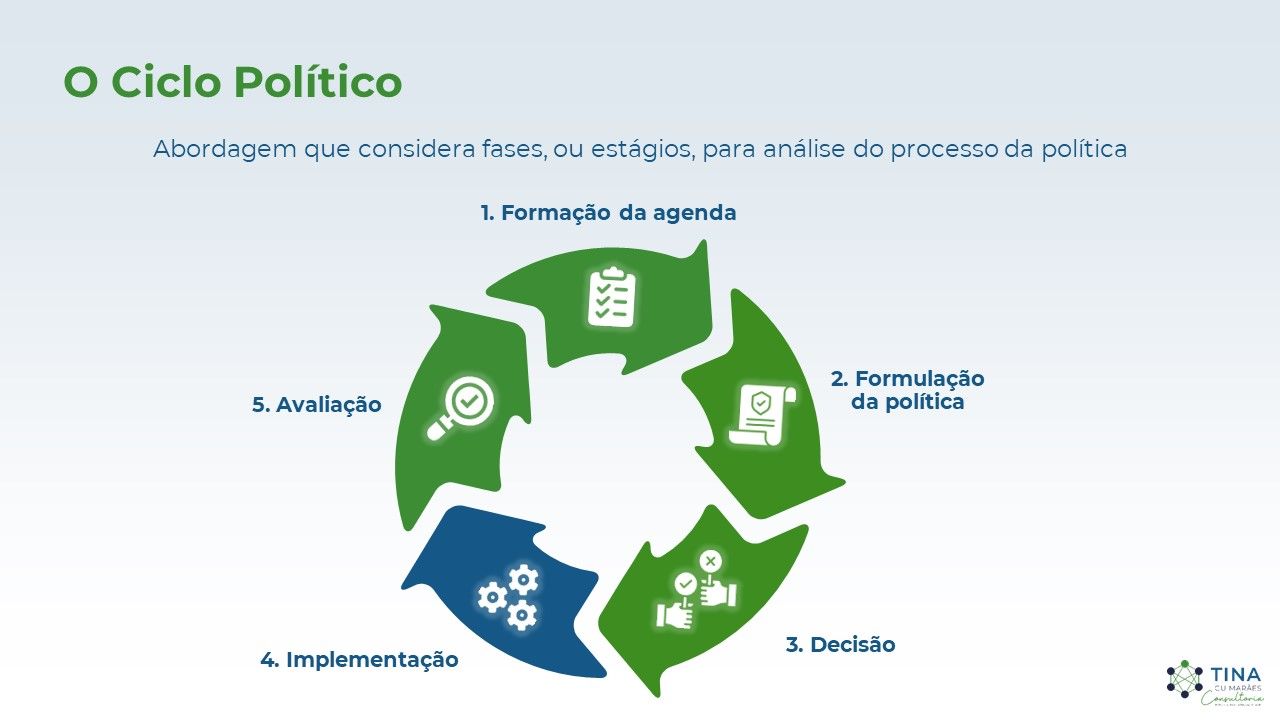
From formulation to implementation
Until the 1970s, political scientists paid more attention to agenda setting in policy formulation and stages of the decision-making process, assuming that a well-designed policy would automatically translate into successful implementation. Over time, however, it became clear that flaws were intrinsic to the implementation process. It was realized that this phase required considerable attention, and the implementation process was no longer neglected. Studies have evolved since then, with the 1980s marked by the search for a theoretical framework and hypotheses about implementation; the 1990s were organized in order to build a bridge between theoretical approaches by developing case studies and building empirical evidence to test the models.
In previous articles, we saw that the formulation of a policy must rely on precise definitions of its objectives, operational elements (instruments), guidelines, and institutional arrangements. The government has a series of instruments in the political design intended to provoke actions and attitudes from society, whether to solve public problems or achieve policy objectives. However, public policy decisions are, ultimately, governmental decisions. Policy design and implementation are closely related because the choices made in the design will profoundly influence how the policy is implemented, which, in turn, influences its results.
A classic example of the difficulty in separating formulation from implementation can be seen through one of the most widely used political instruments: the law-making process. The approval of a law by a legislative body does not result in immediate action by the Executive, or compliance by those who will be affected by this decision. If it was created to impose the mandatory provision of services to the population, for example, it needs to be regulated within the Executive branch and detailed to put the legal text into practice. This is the case, for example, with Ordinances, which do not have an autonomous manifestation, being created to regulate the execution of a law, to determine compliance with an instruction.
The implementation phase is critical to the success of a program because it is during this phase that most of the contact between society and the State takes place.
Implementation Approaches
Over the years, various approaches have been proposed to analyze the implementation of a policy. Among the most common approaches are top-down and bottom-up, which will be explained in more detail below.
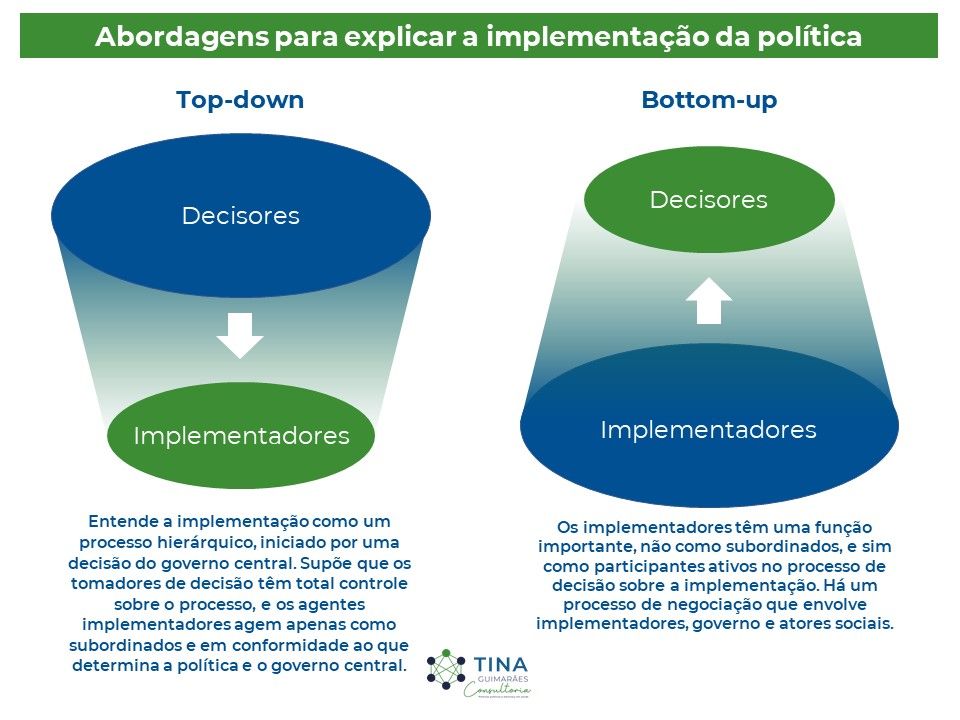
The top-down approach was developed by policy analysts between 1960 and 1970, in empirical studies on implementation failures. In this approach, policy design is crucial, because if the objectives are not clear, implementation already begins with difficulties. The conditions for implementation from this perspective, therefore, are that the objectives are clear and logical, that there are appropriate incentives to influence the behavior of implementers, and that they are committed and have sufficient skills to perform their function. In the top-down approach, there is a perception that there is adequate support from interest groups and the government itself, and that there are no changes in socioeconomic conditions that could undermine political support or the causal theory behind the policy.
The biggest criticism of this approach, as to be expected, is that it does not correspond to reality, as all these conditions are rarely satisfied during the implementation process. For this reason, the bottom-up theory emerged in the 1970s and 1980s as a critical response to the top-down approach.
Unlike the top-down approach, in the bottom-up approach, implementers have an important role, not only as policy managers but as active participants and assistants in improving the defined policies (often reformulating the policy objectives themselves).
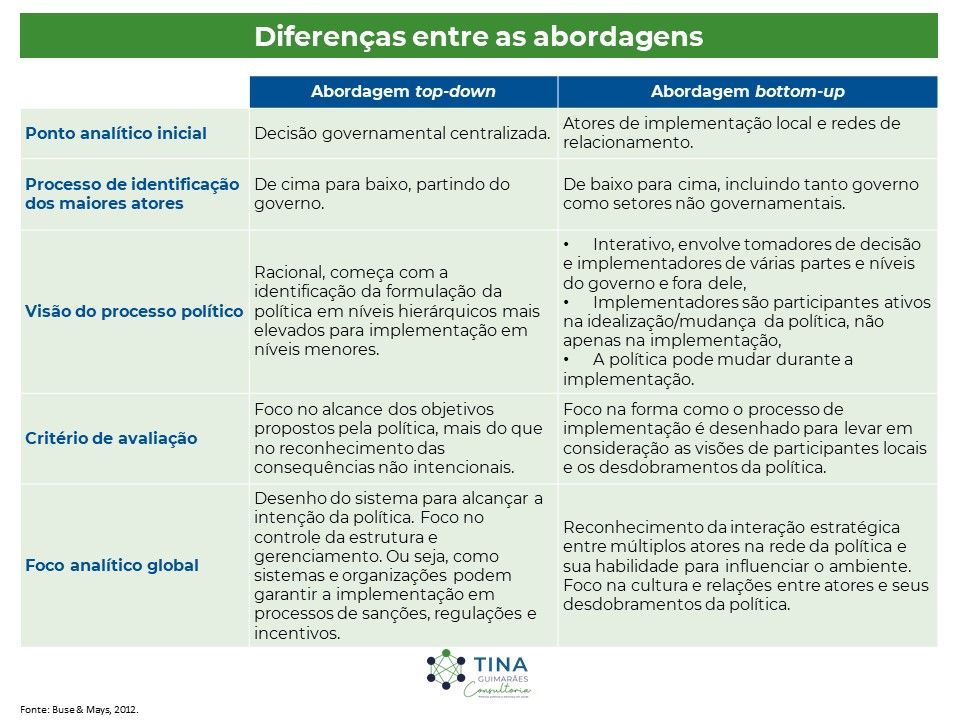
In this approach, the following conditions must be satisfied: the existence of engaged employees on the front lines of the administration (what the authors call street-level bureaucrats), a good relationship between the policy idealizer and the endpoint that will implement it, and good communication and engagement among all implementers. It can be seen that participation and the relationship between all levels are fundamental, there is a decentralization in problem-solving and, therefore, fewer flaws are observed in the results of the policy implemented under this focus. The chart below summarizes the main differences between the two perspectives.
The policy implementation phase is so critical that the synthesis document for Evidence-Informed Policies (EIP) - mentioned in the article on policy formulation in this series - has a section dedicated to implementation barriers, in an attempt to have implementers consider flaws observed in other contexts where similar policies were adopted.
After years of studying this phase in the policy cycle, the literature points to some consensuses:
a) The implementation phase is a continuum between central and local government. Implementers' preferences and negotiations among the entire network that makes up the implementation must be taken into account with the same magnitude of importance as the definition of policy objectives;
b) Implementation is much more than a mere technical execution of political orders coming from above. It corresponds to a political process in itself, which contributes to the remodeling or even a complete change in policy objectives;
c) Formulation and implementation are interdependent processes, not isolated stages in the cycle. Furthermore, external influences from other policies or other contexts (socioeconomic, for example) must be taken into account.
How can societal groups assist in policy implementation?
The literature itself indicates that social and market actors can act as partners in the implementation of programs primarily designed in the public sector. The following examples are not exhaustive but illustrate some ways in which society can contribute to this stage of the policy cycle:
a) With direct action in implementation
Ø When non-governmental welfare entities establish partnerships with the government, they are acting as executors of the policy. Since 2014, with the Regulatory Framework for Civil Society Organizations (MROSC) - in effect since 2016 in the Union, States, and Federal District, and since 2017 in municipalities - new legal instruments were established between the government and social organizations. These are: Fostering and Collaboration, in the case of partnerships without financial resources, and Cooperation Agreements, for partnerships without financial resources. The stages established in the partnership are very similar to the bottom-up approach, as everyone is involved in idealizing the entire process: a) planning, b) selection and signing of the partnership, c) execution, d) monitoring and evaluation, e) accountability. More details about MROSC, the forms of partnership with the government, and other examples can be found at:
http://plataformamaisbrasil.gov.br/images/docs/MROSC/Publicacoes_SG_PR/LIVRETO_MROSC_WEB.pdf
b) Closely monitoring the policy implementation process
Ø As previously mentioned, the approval of a law does not mean its immediate execution, nor that the process will take place as planned. A very interesting example of monitoring a law (understanding the formulation, decision, and implementation phases) is what the Oncoguia Institute did with the 60-Day Law. This law, in force since 2012, establishes that the start of oncological treatment (for any type of cancer) must be initiated within 60 days of the signing of the therapeutic report (exam) or in a shorter period, depending on the therapeutic need of the case. In order for it to be executed, this law would need to be regulated by the competent body, in this case, the Ministry of Health, which occurred in 2013. However, in the regulation process (which in this case we can already think of as the beginning of the implementation phase) there was a change in the understanding of when this treatment should start: the regulation established that the start of the 60-day period should be counted from the date the diagnosis was recorded in the patient's medical record (first consultation after the exam was performed). The Oncoguia Institute noticed this change and initiated a massive articulation effort with members of the Public Prosecutor's Office, Public Defender's Office, National Congress, the Ministry of Health itself, with the support of the press and several other patient associations so that the excerpt would be changed to what the law provided. Since the first consultation after the exam can take months, this new excerpt in the regulation would not solve the need for timely treatment for greater survival and quality of life for patients. The attention given to official documents and all the advocacy efforts that came to revoke this excerpt in the Ministry of Health Ordinance are a good example of the kind of monitoring that civil society can exercise both in implementation and in all phases of the policy cycle.
c) Generating evidence to verify the effectiveness of implementation
Ø Still considering the 60-Day Law, the Brazilian Federation of Philanthropic Institutions to Support Breast Health (Femama) was of great relevance in evaluating the effectiveness of the implementation of this law, after the success in revoking the excerpt of the law to the original. In 2014, it conducted a nationwide survey with state public administration, hospitals, and cancer treatment centers in the Unified Health System to identify the main difficulties and assess whether treatment was actually starting within 60 days, as required by law. The results were presented at a public hearing in the Senate, and a large patient and society mobilization campaign was held to demonstrate that the law was still not fulfilling expected results. Evidence-based advocacy drawn from monitoring the implementation process of a policy can be a great ally for improving health and other services in general.
The literature points out that the law is the political instrument that demands the greatest care in the implementation process. It is essential to recognize organizational routines and preferences for particular political instruments to minimize the risk of failure.
It is easier to implement a law if it has good acceptance and compliance among all involved, which is why articulation with implementers (the organizational level of government) is so important. That is, when proposing a law that involves organizational levels of government, civil society organizations can achieve more effective results by talking to and involving these groups, to know the best way to improve the service. Consensus may be difficult to achieve, but it is a worthwhile effort to reduce barriers and achieve results over a shorter time horizon.
Suggested bibliography:
Birkland, T.A. An introduction to the policy process: theories, concepts, and models of public policy making. 3rd ed, 2011.
Buse, K.; Mays, N.; Walt, G. Making Health Policy. Second edition, Open University Press, 2012.
Faria, C.A.P. (Org). Implementação de políticas públicas: teoria e prática. Editora Puc Minas, 2012.
Fischer, F.; Miller, G.; Sidney, M.S (editors). Handbook of Public Policy Analysis: theory, politics and methods. CRC Press, 2007.
Hill, M. Hupe, P. Implementing Public Policy: governance in theory and in practice. Sage Publications, 2002.
Peters, B.G. (2015). Advanced introduction to public policy. Cheltenham: Edward Elgar. 2015.