
Key messages:
- Decision making in public policy is, ultimately, a governmental decision;
- The government has a series of instruments in policy design with the intention of provoking actions and attitudes from society, whether to solve public problems or achieve policy objectives;
- Fees, subsidies, laws and regulations, loans, transfers, direct provision of services, taxes are examples of these instruments;
- The definition of policy instruments involves different decision-making models, each with its own characteristics. Understanding these models is a way of organizing thoughts and acting strategies;
- Although the final decision on a public policy is the government's responsibility, society can also participate in this process. Social participation in the SUS (Law No. 8,142/90) is a highly relevant example of this influence;
- The existence of participation channels does not indicate that all voices will be heard. The more equipped with evidence, the more institutionally organized, and with greater capacity to mobilize and dialogue, the better the actors will be to support problem-solving.
In this third article of the series on advocacy work in the policy cycle, we will talk about a crucial moment for policies: the decision-making process.
The instruments of policy design and decision
When we talk about a decision on public policy, we are ultimately talking about a governmental decision. The government is the entity responsible for the final decision regarding what will be done to solve a problem or achieve an objective. And it is the one that has a series of mechanisms, or instruments, in the political design with the intention of provoking people to do something, abstain from certain behaviors, or continue doing things they would otherwise not do, in order to solve public problems or achieve policy objectives.
These instruments can be categorized in their economic, legal, informational, social, and political dimensions, practical examples of which are fees, subsidies, laws and regulations, loans, transfers, direct provision of services, taxes, among others. And all are subject to a high degree of government control. Contemporary societies tend to be more resistant to direct government power than in the past, and, in this sense, less coercive instruments tend to be more acceptable, according to Peters (2015).
In recent years, instruments that rely on information, ideas, and a psychological or behavioral dimension have become more common in public policies. The book Nudge, by 2017 Nobel laureate economist Richard Thaler, in partnership with Cass R. Sunstein (professor and founder of Harvard's Program on Behavioral Economics and Public Policy), deals precisely with this issue: the behavioral dimension as defining individuals' choices. The basic idea of a nudge is to promote subtle incentives (or disincentives), without obvious government interference, that lead people to make good decisions. The central point is to encourage the adoption of certain behaviors through incentives, not impositions.
Despite the greater or lesser relevance of types of instruments in a given social and historical context, understanding how policy instruments are selected involves understanding:
- A set of social and individual factors;
- The function of institutions in selecting instruments (for example, regulatory agencies tend to adopt legal instruments);
- The information (including ideas from professional groups or other experts with clarity and evidence on viable options for solving problems);
- The economic interests (availability of resources) and political interests (the political viability for adopting one instrument or another, largely dictated by social pressure, according to some authors).
The literature points out that these factors need to be analyzed together, as there is no clear answer regarding the best instrument to use. But it is worth noting that common interests regarding a certain criterion favor the formation of coalitions among societal groups.
Decision-making models
The definition of policy instruments involves different decision-making models. It is important to emphasize here that the decision can correspond to both the act of acting on a given matter and inaction. All these are products of policy. Decisions can be grouped under the following models:
- Rational decision model: assumes that people are rational in their choices, and use the best information both about the problem and the solutions. The ultimate goal is to maximize social gain, by analyzing the various options available for problem-solving. Critics point out that this model is unfeasible because people do not have all the information about a given problem or solution, there are interests involved in the choices, and different perceptions about all the issues. Despite this, the use of evidence and the development of information systems are valid and necessary tools to make the decision as rational as possible.
- Bounded rationality model (or incrementalism): recognizes the limits and the availability of resources that people have on hand to process information. In this case, people would behave rationally up to a certain limit, even if there is an effort to overcome these limits, which can be dictated by the availability of time, capacity to understand and process information, or to recognize all characteristics or patterns of the problem.
- Garbage can model: assumes that organizations are not perfect and operate in a state of anarchy (that is, without rigid rules), where preferences and processes are not so clear and there is a certain degree of autonomy in decisions. Furthermore, there is no clear link between problems and solutions, and decisions are disconnected from both; they simply coexist in the same space (hence the name “garbage can” model, where everything mixes together). In this approach, it is as if there were people with solutions waiting for a problem where they can use them, and problems waiting for solutions. The role of participants in society is very important, as they are the ones who will find the best time to put the problems on the table or the solutions they have. There are decision opportunities when the three elements connect, such as when an election occurs, a crisis, among others (in this sense, this model is similar to Kingdon's agenda-setting model, discussed in Article 1 of this series).
There are other models, such as the political bureaucracy or conflict-based government policy, but the central point here is practical application. Understanding these models helps us to view reality as an external observer, and understand the motivations and decision-making process in different contexts. In other words, it is a way of organizing thought and acting strategies for issues that are pertinent to everyone, and to the collective interest.
The influence of societal groups on decision making
Although the final decision on public policy is the responsibility of the government, society can also participate in this process. Social participation can be seen as a perception of what is desirable in society, what people want and value and, at the same time, favors the democratization, decentralization, and demystification of the public policy process.
In health, for example, the social participation established by Law No. 8,142/90 corresponds to one of the organizing principles that govern the Unified Health System (SUS), from the creation of Health Councils and Health Conferences, and management collegiate bodies in health services. They can be seen as a way of inserting or delegating part of public decisions to society. In addition to these two formal channels of participation in the SUS, the population can also support decisions in health or other areas through public hearings and consultations. The chart below shows these participation channels and examples of how to act in these spaces, in the context of health.
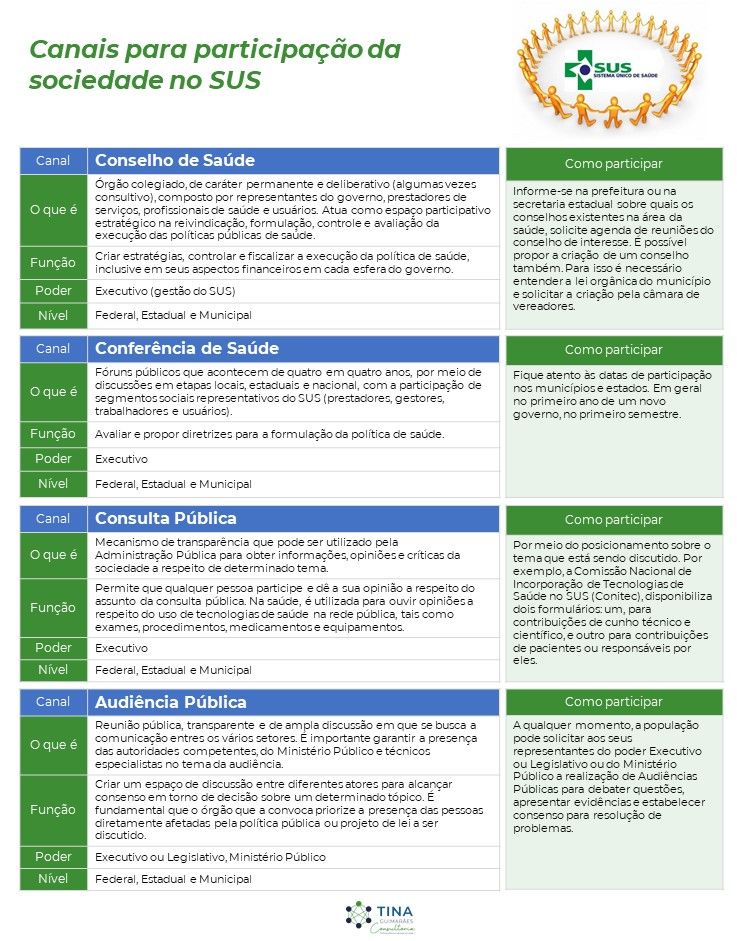
However, the existence of these participation channels does not indicate that all voices will be heard. If we think about the characteristics of all the decision models presented, we can see that the more equipped with evidence (rational decision model), the better the actors will be to support problem-solving. However, mobilization, articulation capacity, and the credibility of institutions are important allies to achieve greater persuasion, as the argumentative approach (result of experiences, life experiences, perceptions, and visions) is an ally to the rational, more technical approach. Buse et al (2012), for example, propose a way of evaluating societal interest groups based on their capacity to influence policies, as can be seen in the figure below.
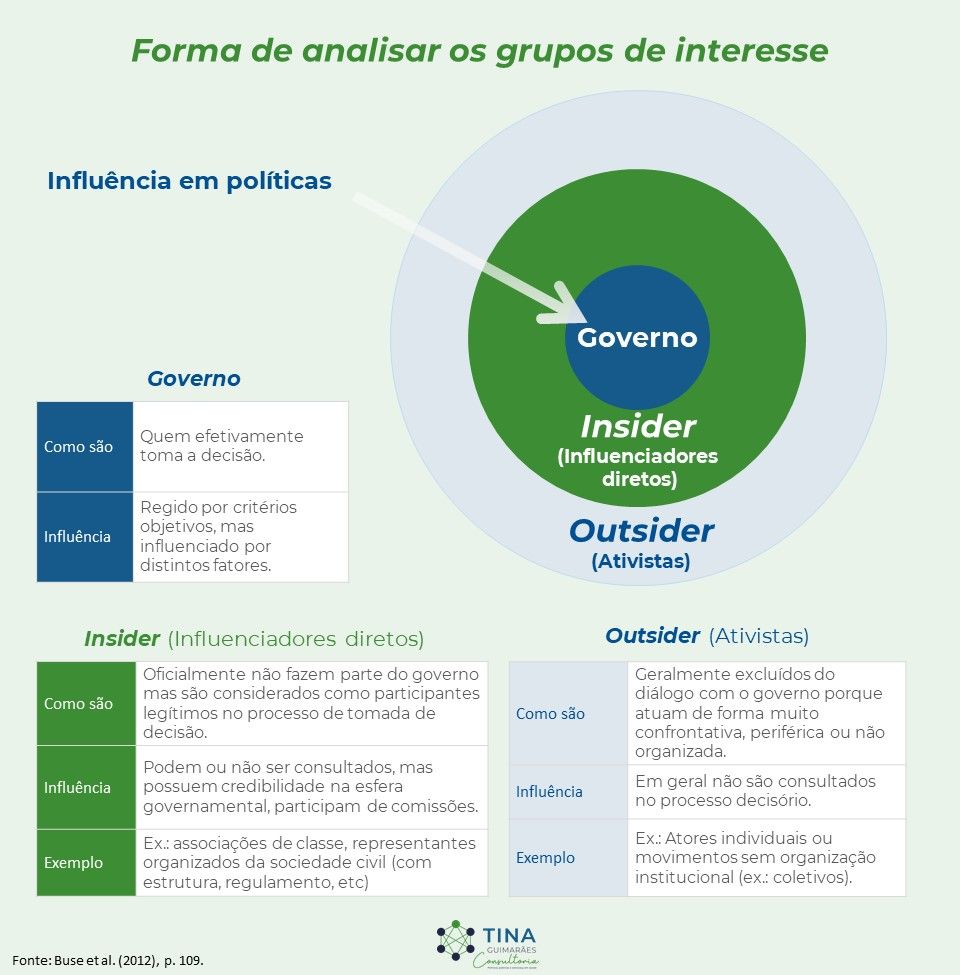
Under this logic, those with the least decision-making power correspond to the most combative groups or actors, and movements without formalized institutional organization. On the other hand, those with greater capacity to dialogue (even when in opposition), and with greater institutional organization, have better chances of influencing decisions. Often these groups are invited to debates and participate in commissions.
An interesting example of a change in political influence strategy corresponds to Greenpeace's actions. Initially, the organization had a more combative action (who doesn't remember Greenpeace boats in front of large whaling ships?), favoring direct action as a way of calling attention to the issues they defend. In recent years, however, the organization has adopted an advocacy strategy based on evidence, including financial support for the development of research and greater communication with the government. Greenpeace corresponds to a case documented in literature as what Buse et al (2012) call a “borderline group”. This means that despite this change in strategy, they cannot be considered complete direct influencers, as they still have more combative actions in some situations, thus situating themselves between the outsider and the insider.
In the next article in the series, our focus will be on policy implementation, which corresponds to the process of transforming policy into practice or action.
Suggested bibliography:
Birkland, T.A. An introduction to the policy process: theories, concepts, and models of public policy making. 3rd ed, 2011.
Buse, K.; Mays, N.; Walt, G. Making Health Policy. Second edition, Open University Press, 2012.
Fischer, F.; Miller, G.; Sidney, M.S (editors). Handbook of Public Policy Analysis: theory, politics and methods. CRC Press, 2007.
Peters, B.G. (2015). Advanced introduction to public policy. Cheltenham: Edward Elgar. 2015.