

Key points of the article:
- The formulation of a policy must rely on precise definitions of its objectives, operational elements (instruments), guidelines, and institutional arrangements
- The concept of policy design advocates that its formulation process should look at the past, to understand the causality of problems. This process is crucial for policy design, since the better its design, the more likely it is to be successful in implementation
- The formulation phase is critical in the policy cycle because the design of alternatives influences the political choice, which also expresses the power among social, political, and economic forces
- Evidence is a very useful tool in the policymaking process, but it is not the only variable capable of influencing decision making. The engagement of societal groups also plays a fundamental role in the policymaking process, exemplified by the case study of HIV/AIDS in the world
What it means to formulate a policy
In this article, we will address the second phase of the policy cycle, referring to policy formulation.
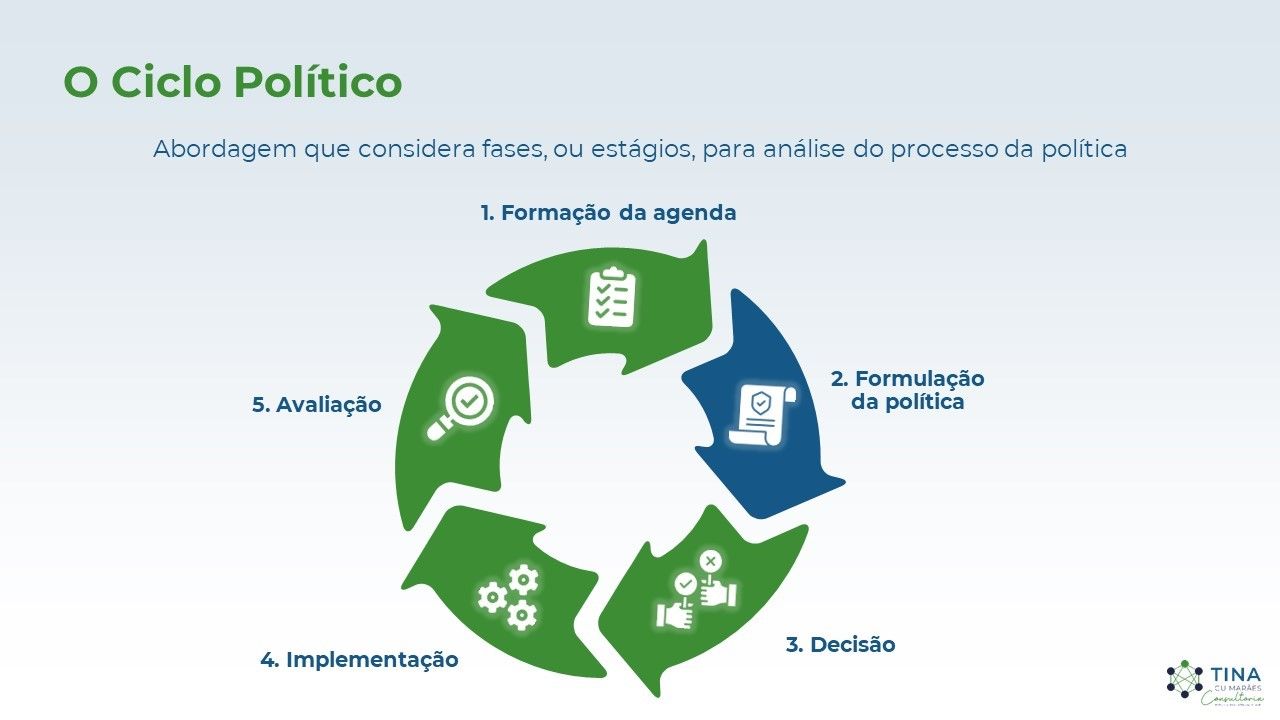
This phase corresponds to the moment that precedes the decision making regarding the policy, and assumes that the problem has already been recognized by the actors and filtered for inclusion on the agenda. What the policy formulation phase intends to define, then, are the viable policy options to solve the problem. Some authors mention that this phase involves the “What/which” question:
- What is the plan to deal with this problem?
- Which options for solving this problem are available and viable for implementation?
- What are the costs and benefits associated with each of the options?
- What are the externalities associated with each of the options?
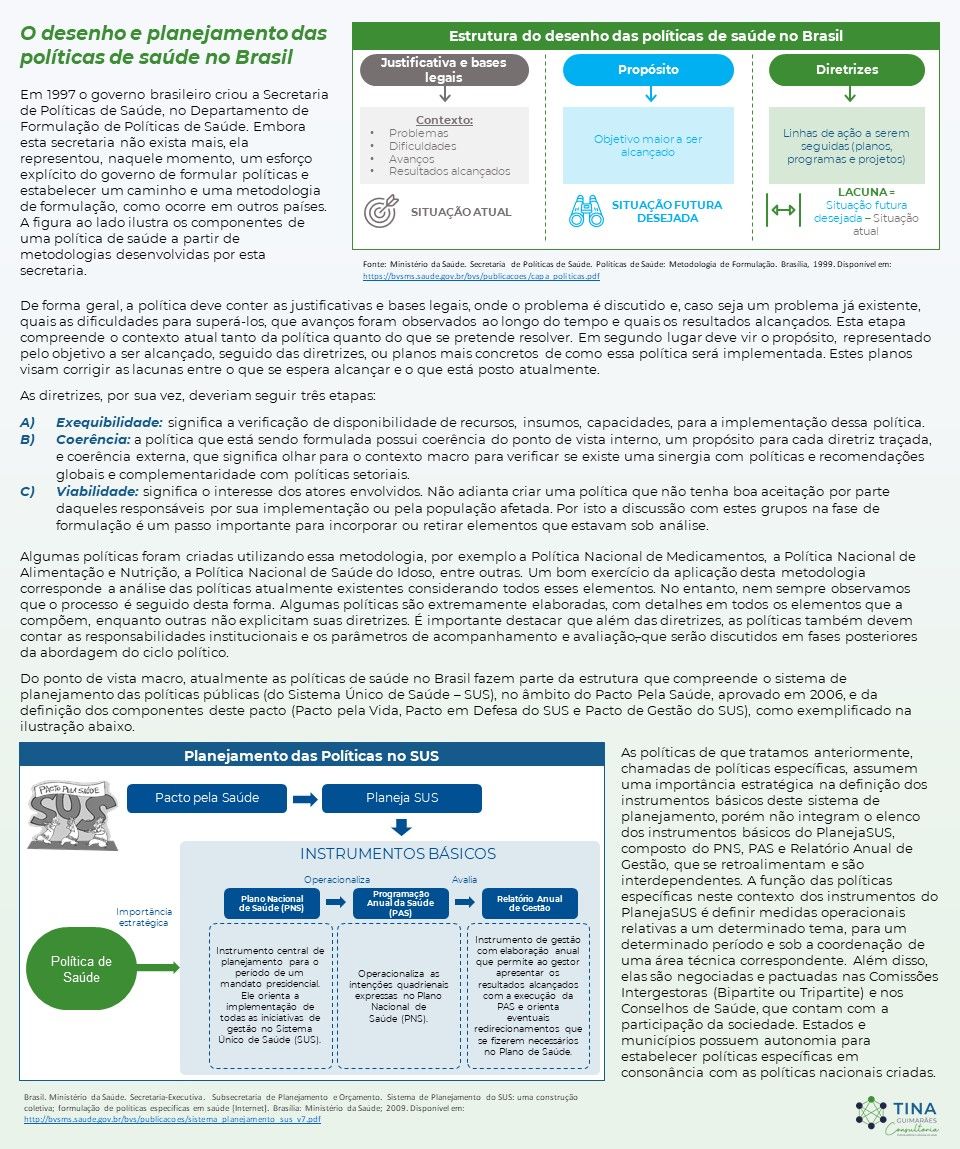
In this sense, the formulation of a policy must rely on precise definitions of its objectives, operational elements (instruments), guidelines, and institutional arrangements. At the end of this article, we present the design of health policies in Brazil and planning tools in the Unified Health System (SUS), in order to provide a clear example of health policy instruments in the country.
The policy design
The most recent literature on policy formulation uses the concept of policy design to argue that its formulation process should look to the past, in the sense of understanding the causality of problems, and understanding why previous policies failed. This process is crucial for policy design, since the better its design, the more likely it is to be successful in implementation.
A 2004 World Health Organization (WHO) initiative seeks to stimulate the use of scientific evidence, especially systematic reviews, in designing viable health policy and program options based on problem recognition. This process - known as EIP (Evidence-Informed Policies) - analyzes different alternatives from an evidence-use perspective, which is important because it relies on robust instruments for analyzing solutions based on experiences documented in the literature.
This methodology addresses details about the benefits, costs, uncertainties, and impact on specific groups of the policy options considered and incorporates implementation elements from the perspective of users, health services, and the health system. More details about this process in Brazil can be found on the website of EVIPNet Brazil (Evidence-Informed Policy Network), a network coordinated by the Department of Science and Technology (Decit) of the Secretariat of Science, Technology and Strategic Inputs (SCTIE) of the Ministry of Health (MS) since 2007. Click here to learn more. This methodology aims to translate scientific knowledge for the manager in a palatable way, so that they can define alternatives for solving problems and that helps them formulate and, then, make a decision about the most appropriate policy with the greatest chances of acceptance and implementation.
The formulation phase is critical in the policy cycle because the design of alternatives influences the political choice, which also expresses the power among social, political, and economic forces (a subject that will be covered in the next article, on the decision-making process). Evidence is a very useful tool in the formulation process, but it is not the only one capable of influencing the choice of those responsible for making decisions. According to Hill (2014), the analysis of a public policy must be viewed through power in society, not just the power to include topics on the governmental agenda, but the power to influence policy formulation and implementation. Therefore, much of the literature on the formulation part of the policy is dedicated to understanding the role of societal groups in this process.
The role of societal groups in the policymaking process
The policy formulation stage is less visible to society than the agenda-setting process (which requires strong mobilization), because it involves internal work with interest groups, legislative houses, special commissions, that is, among those responsible for its formulation and experts on the topic.
However, civil society can also demand the construction of a public policy and support the discussion of solutions based on robust evidence and their own experiences, and exercise social control over the formulation process. According to the Ministry of Health itself, "the formulation process must therefore seek the broadest and most effective participation possible from public bodies, teaching and research institutions, private enterprise, representative entities of professionals and civil society involved with the theme" (Ministry of Health, 2009).
A very eloquent example of the participation of societal groups is given by the case study of global HIV/AIDS policies, summarized by the timeline in the chart below. The full reference can be seen in Buse, Mays & Walt (2012).
Case study
Check out the case study: the history of the role of civil society groups in global HIV/AIDS policy.
The successful case of advocacy by AIDS patient groups even spurred the resurgence of advocacy for specific diseases starting in the 1990s, such as breast cancer and diabetes (Gilkey et al, 2008), and the strengthening of these groups from then on, with greater professionalization and training for political incidence work.
In the next article we will talk about the decision-making process, including the discussion of policy tools used to operationalize policy design. These tools could also be included in this article, but we will leave them for the next one because they constitute a fundamental part of policy decision making.
Suggested bibliography:
Birkland, T.A. An introduction to the policy process: theories, concepts, and models of public policy making. 3rd ed, 2011.
Buse, K.; Mays, N.; Walt, G. Making Health Policy. Second edition, Open University Press, 2012.
Fischer, F.; Miller, G.; Sidney, M.S (editors). Handbook of Public Policy Analysis: theory, politics and methods. CRC Press, 2007.
Gilkey, M.; Earp, J.; French, E. What is patient advocacy? In: Earp, J.; French, E.; Gilkey, M. (Eds). Patient Advocacy for healthcare quality, (pp. 3-28). Sudbury, MA: Jones and Bartlett, 2008.
Hill, M. (2014). Studying Public Policy: an international approach. 1st ed., Bristol University Press, Clifton, Bristol, 2014.
Knoepfel, P. et al. Public policy analysis. The Policy Press, 2007.