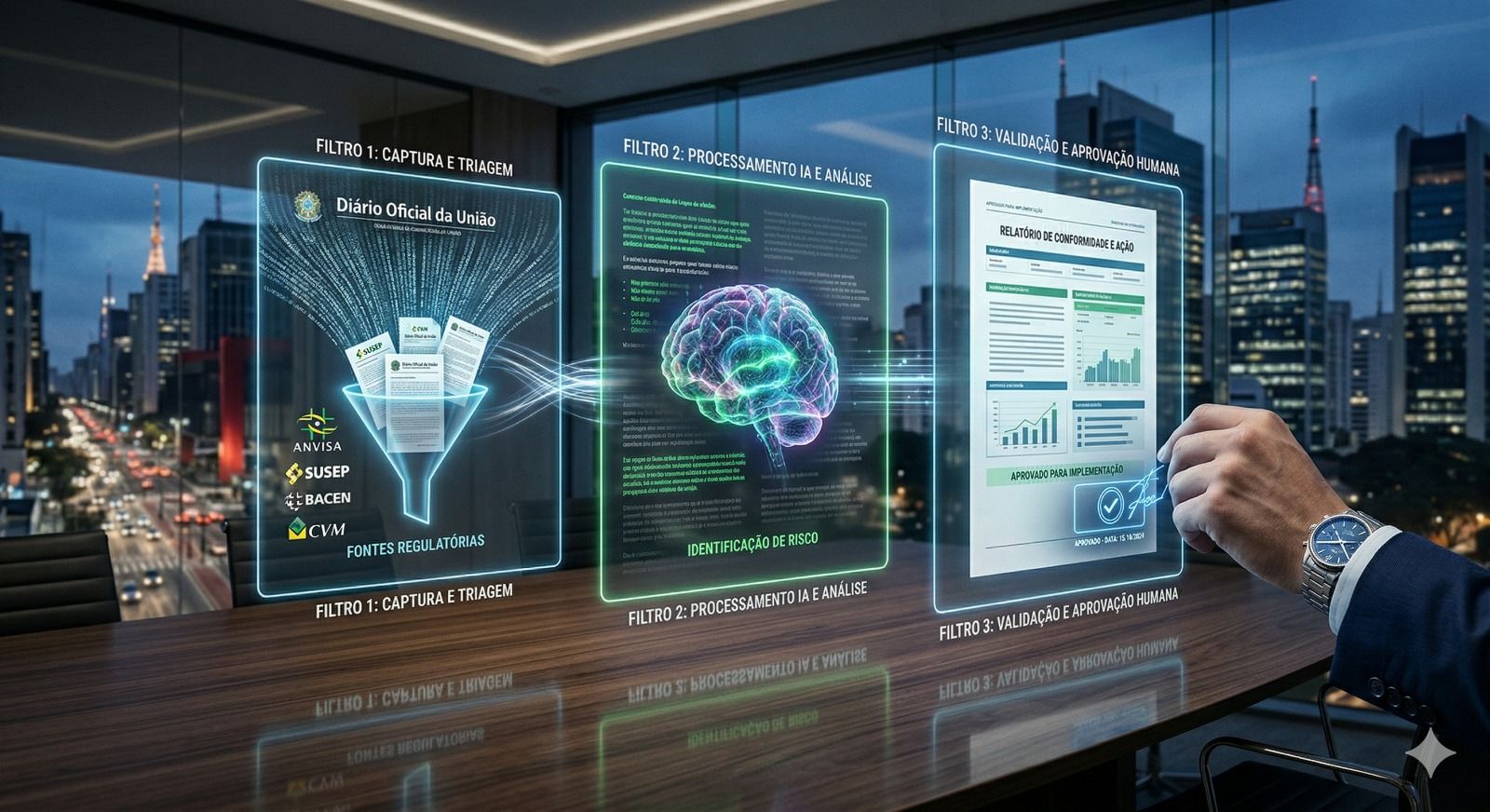

Intelligence is the ability to acquire, understand, and apply knowledge to formulate judgments and direct decisions. In the business environment, this skill manifests as a crucial tool, amplifying the impact of our actions and shaping the world around us. In an era of accelerated changes, we aspire to decisions that are not only intelligent but also well-founded.
That said, the primary step in building this political and regulatory intelligence is deciphering what unfolds in the real world, highlighting emerging opportunities and risks. However, we face a contemporary dilemma: the overwhelming volume of information generated daily often eclipses our capacity for absorption and analysis. Given this scenario, the question arises: are we destined for a superficial understanding of reality, restricting ourselves only to what is within our immediate reach? Is every choice we make similar to the uncertain result of a coin toss?
I refute this limiting perspective. I believe that, armed with the appropriate methodologies and tools, we have the power to expand our understanding beyond what we perceive sensorially. We can embrace the human capacity for abstraction, resulting from synthesis and extrapolation.
And what would this methodology be that allows us to decode the world with agility and efficacy, leading us to logical deductions and a deep understanding of reality?
The starting point for building this methodology lies in discerning the intrinsic dynamics of the political and regulatory scenario. A key observation is that its participants and entities operate in a network structure, resisting rigid and watertight classifications. Connections are constantly established and undone, transmitting a myriad of information that expresses desires, objections, restrictions, and more. Thus, it is imperative to adopt a network modeling approach. We need to map the actors involved, establishing and qualifying the interconnections and information flows between them. In short, it is vital to identify the "management objects" - tangible or conceptual entities that guide our decisions. For example, when we say "President Lula appointed Simone Tebet" or "Fernando Haddad leads the tax reform", we are implicitly recognizing such objects.
To exemplify visually, we put together an example based on a statement by Minister Fernando Haddad representing this dynamic can be represented by a web of geometric elements, with lines denoting the interactions and communications between them.
The second crucial step is to understand and qualify the interconnections. When one object influences another, it communicates through various means: writing, speech, or even body language. Thus, in the method we outline, it is essential to capture these manifestations, whether through digital means or direct observations. After collecting this information, it is imperative to categorize and interpret the signals that circulate between the management objects, leading us to the desired level of intelligence.
Through this approach, we gain valuable insights, such as:
- By measuring the signals emitted by a given stakeholder, we can identify whether their interest in a specific topic is growing or decreasing.
- Analyzing the frequency of a stakeholder's signals, we can deduce possible changes in their positioning.
Despite its apparent simplicity, this modeling strategy is powerfully versatile. It offers a flexible prism for organizing and interpreting information. Imagine a Rubik's cube: each turn reveals a unique perspective, unraveling crucial insights for more assertive decisions. After all, the answer to our dilemmas often lies in seeing things in a different light.
I hope this explanation has illuminated your reflection process. If you wish to explore how this methodology can be adapted to your institutional context, do not hesitate to contact us for an enriching conversation!